Home » 2013 (Page 3)
Yearly Archives: 2013
Expert casts light on Stonehenge mystery
 |
| Revellers gather at the World Heritage site at Stonehenge in Wiltshire to watch the sunrise during the summer solstice, marking the longest day of the year |
Revellers gather at the World Heritage site at Stonehenge in Wiltshire to watch the sunrise during the summer solstice, marking the longest day of the year
The thousands of people attending the summer solstice at Stonehenge this year – and for the past 13 years – might have got it completely wrong, for experts have revealed that the ancient monument just happens to align with the solstice sunrise.
Instead, the stones were built to align with an Ice Age landform, a series of naturally occurring fissures cut into ridges in the landscape – and it’s pure coincidence these align with the midwinter sunset in the south west and the midsummer sunrise in the north east.
That is the latest expert view from a lengthy project to discover as much as possible about Stonehenge, led by Professor Mike Parker Pearson, who has had the first chance in more than a century to have a dig around under the A344, one of the two major A-roads that surround the stones.
The road was closed earlier this year, and will ultimately be grassed over, but its Tarmac ran over the path of The Avenue, the ancient pathway that once led to the stones from a nearby river and places where Stonehenge’s users are thought to have lived.
When they dug up the road, they discovered The Avenue is half-natural.
“This natural landform happens to be on the solstice axis, which brings heaven and earth into one,” said Prof Parker Pearson. “So the reason that Stonehenge is all about the solstices, we think, is because they actually saw this in the land.
“It’s hugely significant because it tells us a lot about why Stonehenge was located where it is and why they were so interested in the solstices. It’s not to do with worshipping the sun, some kind of calendar or astronomical observatory; it’s about how this place was special to prehistoric people,” he said.
As well as being allowed to scrape away the layers of history under the newly-closed road, the dry and hot summer of 2013 has also helped to yield new information – thanks to a short hose.
English Heritage keep the grass around the stones well-watered to maintain the lush greenery, but the hose doesn’t reach one corner where the grass turned brown like much of the West this summer.
In the brown patch, two members of staff spotted discoloured areas of grass – or parchmarks – which are the tell-tale sign that mighty stones once stood there.
That means experts are now convinced – even though the presence of stones there once was not picked up on the high-tech surveying equipment over the years – that the outer sarsen circle would have been a complete circle.
“The problem is we’ve not had a decent dry summer in years,” said Prof Parker Pearson. “Stonehenge is regularly watered, and these have shown up only because the hose was too short.”
Stonehenge theories
Local legend had Stonehenge built by Merlin, who brought the bluestones from Wales. For many years, it was assumed the stones’ alignment with the sunrise on the summer solstice meant its purpose was for sun worship. More practically, a follow-up theory had Stonehenge built as a huge and elaborate astronomical clock. One book claimed it was the landing marker for aliens.
Stonehenge Guide
Neolithic skull fragment discovered on banks of Avon from around the time Stonehenge was built.
Archaeologists say ‘exceptional’ find by dog walker near Pershore, Worcestershire, raises more questions than answers.
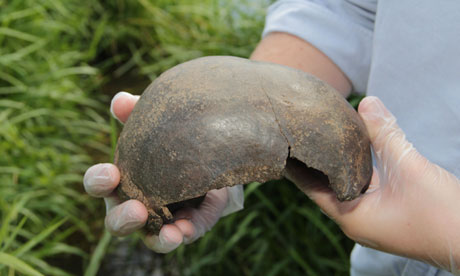 |
| Part of a 5,000-year-old skull found on the banks of the Avon. Archaeologist says that where the fragment was found was unlikely to be where it was buried. Photograph: Richard Vernalls/PA |
A 5,000-year-old mystery has been sparked after part of a human skull was found on a riverbank. Archaeologists said the unbroken piece of upper skull was in “fabulous” condition with the intricate marks from the blood vessels still visible on the inner surface.
There are suggestions it may have belonged to a middle-aged woman from the neolithic period – around the time Stonehenge was built. The skull is also prompting questions about where it may have come from.
A dog walker stumbled across the fragment, which measures 15cm by 10cm (6in by 4in), this year but initially thought it was part of a ball or a coconut shell. The next day he returned to the site on the banks of the Avon near Pershore, Worcestershire, for a closer look and, realising what it was, called police.
West Mercia police contacted experts at Worcestershire Archaeology, who sent the skull to be radiocarbon dated.
“When I first saw the skull, I thought it may have been Anglo-Saxon or Roman but I knew that it was not recent due to the colour,” said Nick Daffern, senior archaeologist. “But we were all surprised when the radiocarbon dating put it at between 3,338 BC and 3,035 BC, or about the middle neolithic period.
“It is so well preserved, it is unthinkable that this had been in the river for any length of time which begs the question as to where it has come from.
“We know of Roman, Saxon and medieval burials along the river, but this is very rare – it is an exceptional find. “
He added: “I don’t think it was found where the remains were buried. I think we’ve got a riverside burial and then flooding has brought this down the river. Finding that burial site though would be like finding a needle in a haystack.”
Daffern said that without the rest of the skeleton it was difficult to draw conclusions about the person found, and certainly there is no clue as to how they met their death.
“Myself and a forensic anthropologist believe it is a woman due to the slightness of the skull and the lack of any brow ridges although our conclusions are very tentative because we’re dealing only with the top of a skull,” he said.
“There’s no trauma to the bone, and where it has broken those are natural breaks, nor is there any sign of disease so we’ve no idea as to cause of death.
“The natural fusion of the bone in the skull leads me to believe it may be an older woman, possibly in her 50s, but that is very tentative again. Unfortunately, it remains a bit of a mystery.”
The find is a few miles from Bredon hill, which has been a scene of human activity down the ages and still boasts the earthen ramparts of an iron age hill fort. However, finds of neolithic remains are rare.
“Whenever we come across neolithic remains, there seems to be a solid dividing line between where they buried their dead and where they lived, and that is no accident,” he said. “But it is frustrating as an archaeologist because although we have the physical evidence, we still don’t have the answers as to why.”
The skull is only the second set of neolithic remains to be found in the county, although two large 6,000-year-old “halls of the dead” were found in nearby Herefordshire this year but without any human remains present.
Article from The Guardian: http://www.theguardian.com/uk-news/2013/aug/30/neolithic-skull-fragment-avon-river-pershore
Stonehenge Tourist Guide
Avebury’s past to be on TV
Presenter Tony Robinson and his production team battled the elements at Avebury stone circle to film part of the four-part series Walking Through History.

Avebury’s past to be on TV
Last week the team visited various locations in the county for the Wiltshire episode of the series, which looks at some of Britain’s most historic landscapes.
Other areas visited in Wiltshire included Devizes, Silbury Hill, the Kennet long barrows and Stonehenge.
Photographer Nicola Salt from Cadley was at the Avebury stones when the filming took place.
She said: “I spoke to someone from the production team and they said they’d really enjoyed the visit. It’s great to see Wiltshire get the recognition it deserves – when you live here you don’t appreciate how lucky you are.”
Full article in the Gazatte and Herald: http://www.gazetteandherald.co.uk/news/10625991.Avebury_s_past_to_be_on_TV/
Stonehenge Travel Company, Salisbury
Best attraction Award for Stonehenge
STONEHENGE has been rated as one of the UK’s best tourist attractions by customers of Irish bus tour operator, CIE Tours International.

Karin Gidlund, from CIE Tours International (centre left), hands over the award to Jon Bichener, Stonehenge retail manager (left) and Stonehenge property supervisors Anneka Harris (centre right) and Kevin Barber (right).
The award acknowledges customer satisfaction of 90 per cent or over, based on feedback from those visiting the ancient stones.
Peter Carson, head of Stonehenge for English Heritage, said: “We are so thrilled to have received this award given our current limited facilities, and therefore it is a real pat on the back for the high standards of service offered by our team to our customers.
With the completion of our new visitor facilities just a few months away we will be able to offer an even better welcome in the future.”
Full story in the Salisbury Journal: http://www.salisburyjournal.co.uk/news/10631514.Award_for_Stonehenge/
Stonehenge Travel Company, Salisbury
 Stonehenge and Salisbury Guided Tours