Home » 2016 (Page 3)
Yearly Archives: 2016
Fundraising Event: A talk by Mike Parker Pearson ‘Stonehenge and Durrington Walls: new research’

Archaeological excavations are being carried out in 2016 at Durrington Walls and in Preseli, to shed yet more light on the mystery of Stonehenge and its stones. Was there a ‘superhenge‘ of standing sarsen stones at Durrington Walls that dwarfed Stonehenge?
 Was Stonehenge itself actually a ‘secondhand monument’, built from bluestones brought from an earlier monument in west Wales? New advances in scientific methods, both in the field and in the laboratory, are also helping archaeologists find out more about the people who built Stonehenge, how they lived and why they went to such effort to build this remarkable structure.
Join Mike Parker Pearson for an evening lecture to hear about the latest exciting developments in Stonehenge’s story.
Salisbury Museum: Thursday, October 13th, 2016 – 18:30 to 20:00
Booking required. Please contact the museum.~
The Stonehenge News Blog
John Constable’s Salisbury Cathedral masterpiece to be shown in city that inspired him.
Painter’s 1831 work completed after his wife’s death is centrepiece of new exhibition at Salisbury Museum.
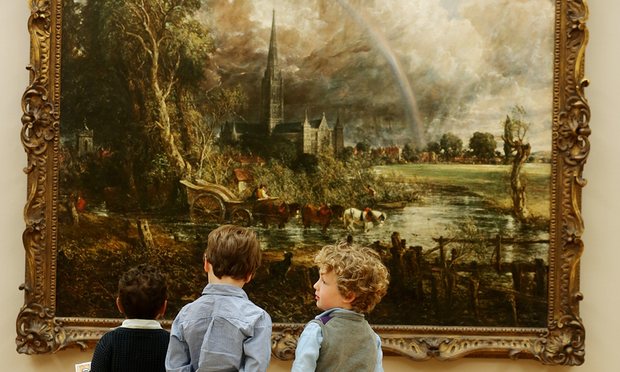
Salisbury Cathedral from the Meadows was bought by the Tate for £23.1m. Photograph: Graeme Robertson for the Guardian
After 185 years, the trees around Salisbury Cathedral have grown taller and thicker, shrouding all but the magnificent tower and spire. But, remarkably, the water meadows are still as lush and unspoilt as they were in John Constable’s day.
This is the view, including the shallow stream that draws the eye toward the magnificent cathedral, painted by the acclaimed British artist in one of his most important and best-known works, Salisbury Cathedral from the Meadows. And for the next six months, there is a rare opportunity to compare masterpiece and present-day view within a few minutes’ walk.
The painting, finished in 1831, is going home to the city for which Constable had a special affection, as part of a five-year tour, taking in Wales, Scotland and East Anglia. From Saturday, people will be able to see it at the Salisbury Museum in the cathedral close, alongside dozens of other paintings, watercolours, etchings and drawings of one of the country’s most awe-inspiring buildings.
“We are very excited that we’re displaying Constable’s masterpiece in the city that inspired him,” said Adrian Green, the museum’s director. “The museum is located opposite the cathedral, backs onto the water meadows and is adjacent to where Constable stayed in the close – so one can literally walk out into the canvas and see a landscape that has changed little since Constable’s time.”
Salisbury Cathedral from the Meadows is one of a series of 6ft canvases painted by Constable. Encouraged by his close friend and archdeacon John Fisher, who lived in the cathedral close, he began to make sketches for the painting while grieving for his late wife Maria.
“Constable drew Salisbury Cathedral many times from different viewpoints,” said Gracie Divall of the Tate, which owns the painting and organised its tour around the UK. “It was the place he visited most outside his home in Suffolk. But this painting is seen as one he poured his emotion into, rather than just depicting what he saw in front of him.”
The turbulent sky provoked much comment when the painting was first exhibited; one Morning Herald reporter remarked that “the sky is in a state of utter derangement”.
Meteorologists have pointed out that the rainbow depicted in the painting would be impossible given the cloud formations. However the Tate has commissioned new meteorological research, to be published this year, which suggested that a rainbow over the cathedral was not beyond the realms of possibility.
“Constable was using the weather to tell a story,” said Divall. Some have interpreted the storm clouds as a reflection of the painter’s turmoil at his wife’s death; others suggest they reflect the storms surrounding the Anglican church – in which Constable was an ardent supporter of tradition against reform – at that time.
The painting was bought by the aristocratic Ashton family in 1850 but was on loan to the National Gallery for many years. When the family decided to sell a few years ago, the National Gallery was already committed to buying works by Titian in the most expensive purchase in its history.
The Tate stepped in, raising £23.1m to buy the Constable, described by the gallery’s director, Nicholas Serota, as “one of the great masterpieces of British art”.
A delicate cleaning process in 2013 “made a huge difference to the vibrancy of the work”, said Divall. “There was a lot of staining, mostly nicotine, from when it was in private ownership and from when people were allowed to smoke in galleries. The painting wasn’t glazed.” The cleaning process had revealed details such as a cow in the bottom left of the painting, she added.
The painting has returned to Salisbury once before, in 2011, when it attracted about 36,000 visitors. The new exhibition runs until 25 March.
Article extracted from The Guardian
Stonehenge and Salisbury Guided Tours
http://www.StonehengeTravel.co.uk
Scientists prove that stone monuments in Britain were built with astronomy in mind


View original post 100 more words
Durrington Dig – 10th August 2016
We are visiting Durringon Walls en-route to Stonehenge.

Durrington Walls Dig: August 2016
We are following this very carefully and including on all our August Stonehenge tours.
Over the course of the last six years a team of archaeologists from across Europe led by Professor Vince Gaffney of Bradford University have been carrying out a series of cutting-edge geophysical surveys across an area approaching 10 square kilometres in the Stonehenge landscape.
They’ve made dozens of new discoveries, some of them entirely new sites. But one of the most astonishing things they’ve found is that something – in fact a whole series of somethings – lie buried beneath the 4,500 year old bank of Durrington Walls henge. Their surveys revealed an arc of large solid anomalies, some over two metres long. But the question was what were they?
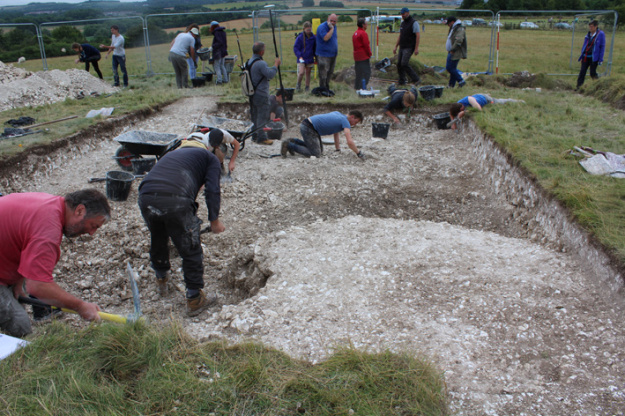
There was only one way to find out and that was to dig. Which is why the combined forces of the Stonehenge Riverside Project, the Hidden Landscapes team and the National Trust are digging at Durrington Walls this August.
At the start of our dig our…
View original post 204 more words
A Day of Archaeology 2016

This year’s Day of Archaeology will take place next week, on 29th July, and judging by the comments on their sign-up page will include many new participants this year!
For those that aren’t aware, the Day of Archaeology project aims to provide a window into the daily lives of archaeologists from all over the world. The project asks people working, studying or volunteering in the archaeological world to participate in a “Day of Archaeology” each year in the summer by recording their day and sharing it through text, images or video on the website.

The project is run by a team of volunteers who are all professional archaeologists, and taking part in the project is completely free. The whole Day of Archaeology relies on goodwill and a passion for public engagement!
The project has been running since 2011, and last year we documented some of our thoughts on the year’s…
View original post 15 more words

A Brief History of the Bronze Age

The recent discoveries of extraordinarily well-preserved 3,000-year-old homes at Must Farm in Cambridgeshire have highlighted the sophistication of domestic life towards the end of the Bronze Age, around 900 BC. But the Bronze Age was a long period, beginning some 1300 years earlier when life was very different to that of the inhabitants of Must Farm.
Here we look at how technology and ways of life in England developed during the preceding millennium.
Written by Dr. Jonathan Last, Landscape Strategy Manager, Historic England.
2000 BC: Ritual Landscapes
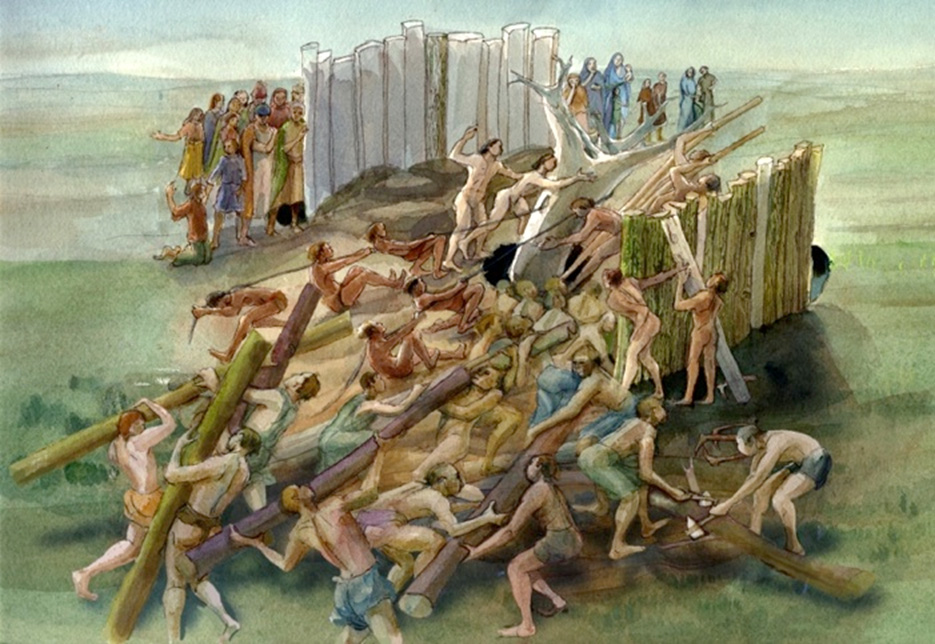 Reconstruction by Judith Dobie of the timber circle at Holme-next-the-Sea.
The Early Bronze Age was a landscape of monuments; the roundhouses, enclosures and fields that typified the time of Must Farm were yet to appear. The most familiar sites from the period were round barrows, but there was also a range of other small circular monuments that were constructed from wood, stone…
View original post 687 more words
 Stonehenge and Salisbury Guided Tours