Home » Uncategorized (Page 11)
Category Archives: Uncategorized
How many people did it take to build Stonehenge? Volunteers drag ONE-TONNE concrete slab to recreate Stone Age effort
- Volunteers dragged the a concrete slab using neolithic-style wooden sled
- The slab weighed half as much as the smallest blue stone at Stonehenge
- A video appears to show 20 people pulling the slab along logs with ropes
- Organisers looked to ancient wooden sleds from Asia and non-industrialised cultures for monument building as inspiration
By Abigail Beall and Ryan O’Hare for MailOnline
Towering above the grassy Salisbury Plain, its eerie rock monoliths are steeped in myth and magical stories, yet despite decades of research the original purpose of Stonehenge remains a mystery.
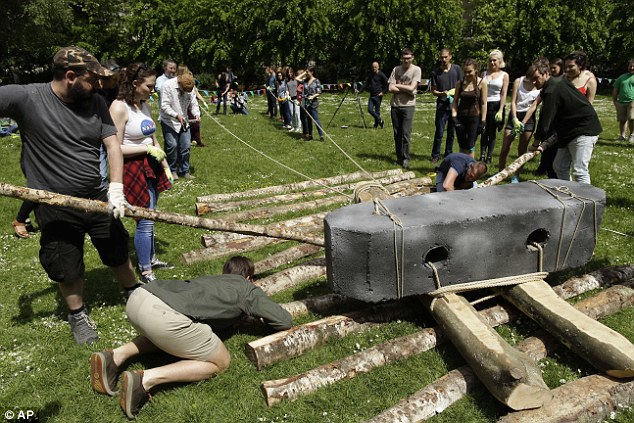
Towering above the grassy Salisbury Plain, its eerie rock monoliths are steeped in myth and magical stories, yet despite decades of research the original purpose of Stonehenge remains a mystery. But UK researchers have tried to answer one of the many logistical questions surrounding the beginnings of the monument – how many people it took to build it. In an effort to to solve the quandary, UK researchers recruited a group of volunteers to recreate the Neolithic building efforts, by dragging a one-tonne slab of concrete using logs and rope.
But UK researchers have tried to answer one of the many logistical questions surrounding the beginnings of the monument – how many people it took to build it.
In an effort to to solve the quandary, UK researchers recruited a group of volunteers to recreate the Neolithic building efforts, by dragging a one-tonne slab of concrete using logs and rope.
Towering above the grassy Salisbury Plain, its eerie rock monoliths are steeped in myth and magical stories, yet despite decades of research the original purpose of Stonehenge remains a mystery.
But UK researchers have tried to answer one of the many logistical questions surrounding the beginnings of the monument – how many people it took to build it.
In an effort to to solve the quandary, UK researchers recruited a group of volunteers to recreate the Neolithic building efforts, by dragging a one-tonne slab of concrete using logs and rope
Read the full story and watch the video here
Join us on a Stonehenge guided tour and here all the latest theories from our local experts
Stonehenge and Salisbury Guided Tours
http://www.StonehengeTravel.co.uk
Stonehenge experiment needs volunteers to help lift one tonne block

Take part in Stonehenge experiment: How many people does it take to lift one block?
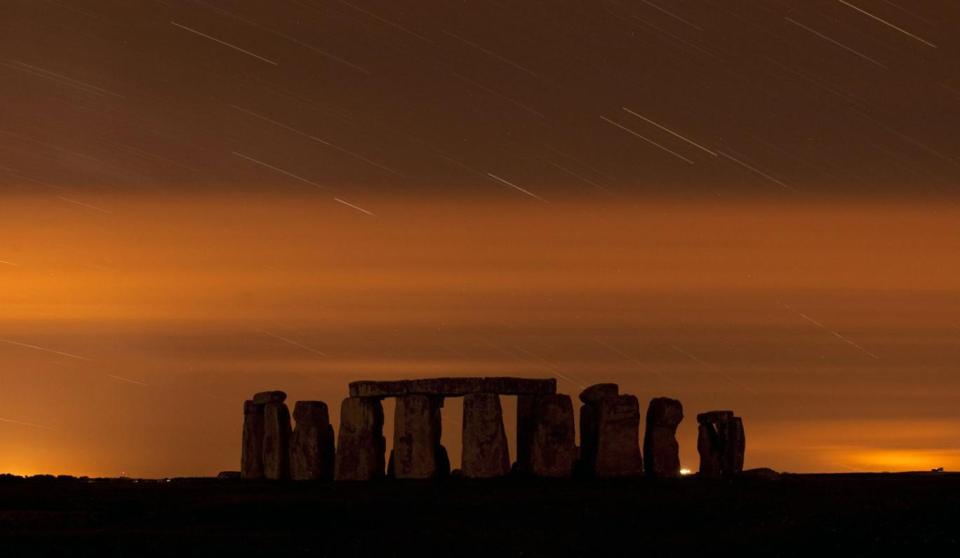 Heavy lifting: the smallest stones at the prehistoric site weigh about two tonnes REUTERS/Kieran Doherty
Anyone who has wondered what it took to lift a piece of Stonehenge into place has a chance to have a go themselves in a mass experiment.
Experts from University College London are seeking volunteers to help them lift a replica stone using prehistoric technology and brute strength.
Doctoral student Barney Harris, who is organising the event in Gordon Square near the UCL campus on Monday, said he believed it would take 40 to 50 people to lift a single stone, which at one tonne is half the weight of the smallest block at Stonehenge.
Mr Harris said: “We will be using a model of a sledge that might have been used, but other than that it will be people…
View original post 94 more words
Anglo-Saxon cemetery teeming with ‘fascinating’ objects is unearthed near Stonehenge for the second time in a month.
- The 1,300-year-old cemetery was found on land marked for development
- Cemetery of 55 graves dates to the late 7th and early 8th century AD
- The majority of the items found in graves were small iron knives
- Combs, pins made of bone, beads and pierced coins were also found
Salisbury Plain may be best known for Stonehenge, but the chalk plateau has revealed other, more hidden secrets over the past month.
In April an Anglo Saxon cemetery of around 150 graves holding beautiful grave goods was unearthed in Bulford, Wiltshire.
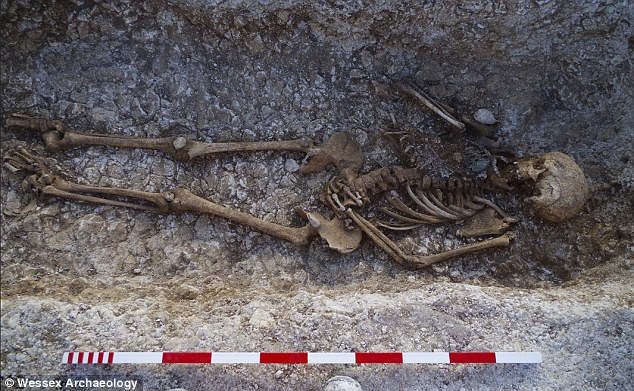
The 1,300-year-old Anglo-Saxon cemetery was discovered on land marked for a £70 ($102) million housing development for army families. The cemetery of about 55 graves (one pictured) dates back to the late 7th and early 8th century AD
And now, another cemetery has been discovered with 55 graves, just 7 miles (11km) down the road in the village of Tidworth.
The 1,300-year-old Anglo-Saxon cemetery was discovered on land marked for a £70 ($102) million housing development for army families.
The cemetery of 55 graves dates back to the late 7th and early 8th century AD.
Most of the the burials contained personal effects or significant items.
The majority of the items were small iron knives, although other finds included combs, pins made of bone, beads and pierced coins thought to form necklaces. There were also several spearheads.
The land, in Tidworth, Wiltshire, is part of a new housing development to build 322 new homes for Army families.
Read the full story in the Daily Mail
Stonehenge and Salisbury Guided Tours
http://www.StonehengeTravel.co.uk
The Anglo Saxon cemetery near Stonehenge: Graves reveal a curious ‘work box’ and ‘fertility’ shells at a site that may have been used for 5,000 years
- Around 150 Anglo Saxon graves found in the village of Bulford, Wiltshire
- Grave goods include a ‘work box’, shells a spear tip and intricate comb
- Nearby site is home to Neolithic chalk goods and carefully arranged bones
- Army site may have been of spiritual significance 5,000 years ago
Salisbury Plain may be best known for Stonehenge, but the chalk plateau hides other secrets too.
Archaeologists have unearthed an Anglo Saxon cemetery of about 150 graves holding beautiful grave goods, including an intricate comb, jewellery, a ‘sewing box’ and intriguing shells in the village of Bulford, Wiltshire.
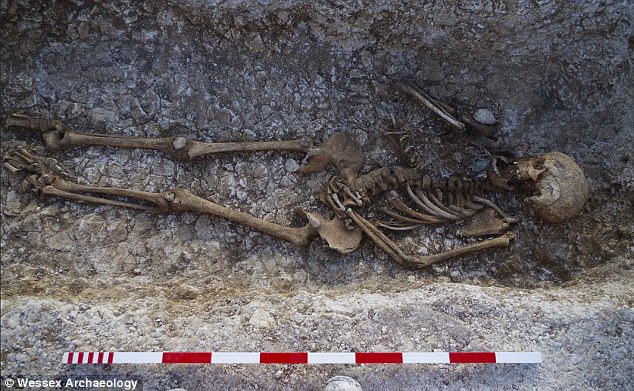
Archaeologists have unearthed an Anglo Saxon cemetery of about 150 graves holding beautiful grave goods, including an intricate comb, jewellery, a ‘sewing box’ and intriguing shells in the village of Bulford. This grave of a woman contains a shell and work box (just seen on the right of her spine and shoulder)
There are also indications the site has been of spiritual significance for 5,000 years with collections of Neolithic goods suggesting it may also have been an important burial site for Stone Age man.
Experts at Wessex Archaeology excavated the site, earmarked for 227 new Army family homes. It is around four miles from the famous Stonehenge circle.
Investigations revealed about 150 graves from the mid-Anglo-Saxon period in England, with one grave dated to between AD 660 and 780.
It held the remains of an Anglo Saxon woman who died in her mid to late 20s and was laid to rest with two boxes and a cowrie shell.
Simon Cleggett of Wessex Archaeology told MailOnline the grave contained a copper alloy ‘work box’ that may have been used as a little sewing box, because pins have been found in similar cylindrical boxes at other sites.
‘But they might be amuletic [served as a lucky charm] – on some occasions they might contain a piece of bone from a saint or a piece of cloth’ he explained, because at the time Christian influences were spreading across the largely pagan population.
The small cylindrical boxes have been found in tens of Anglo Saxon graves as far north as Northumberland and south as the Thames Valley, according to a study by Catherine Hills of the University of Cambridge.
‘Most have some indication that they could be suspended – they have attachment loops and/or chains,’ she wrote.
The work boxes may have been suspended from a woman’s girdle, but then again, they may have been too fragile and unwieldy and could have been carried in a bag, for example.
The box in the grave was found placed next to the woman’s head, which is relatively unusual as it was more normal for them to be buried by the wearer’s legs, based upon others unearthed.
The boxes have largely only been found in the graves of Anglo Saxon women, as have shells.
Two cowrie shells, possibly from as far away as the Red Sea or India, were also found at the site. Mr Cleggett said they may have come from Cyprus, Egypt, Syria or even India.
‘They are almost always buried with women and children,’ he said, explaining they may have symbolised fertility.
Because of the shells’ origins, they shed light on trade links at the time, stretching across the Mediterranean sea and beyond.
One large shell was found in the woman’s grave along with the work box, while another – buried with a child – has a hole in it, meaning it could have been used as a pendant.
Read the full story and see the image gallery on the Daily Mail website
The Stonehenge Travel Company
Stonehenge and Salisbury guided Tours
http://www.Stonehengetravel.co.uk
Roman villa unearthed ‘by chance’ in Wiltshire garden
An “elaborate” Roman villa has been unearthed by chance by a home owner laying electric cables in his garden in Wiltshire.
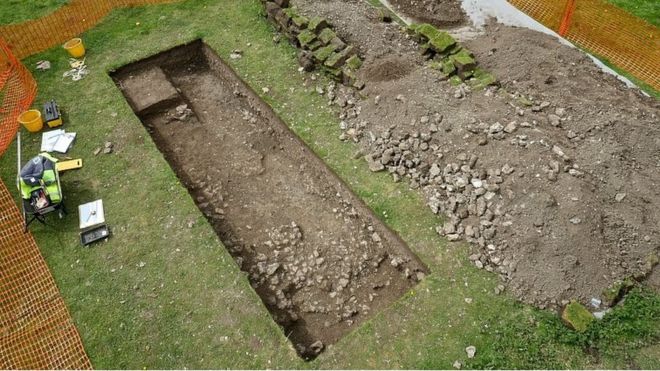
The villa was described as “extraordinarily well-preserved”
It was discovered by rug designer Luke Irwin as he was carrying out some work at his farmhouse so that his children could play table tennis in an old barn.
He uncovered an untouched mosaic, and excavations revealed a villa described as “extraordinarily well-preserved”.
Historic England said it was “unparalleled in recent years”.
Thought to be one of the largest of its kind in the country, the villa was uncovered near the village of Tisbury during an eight-day dig. It is being compared in terms of its size and its owners’ wealth to a similar, famous site at Chedworth in Gloucestershire.
Finds including hundreds of oysters, which were artificially cultivated and carried live from the coast in barrels of salt water, suggest that the villa was owned by a wealthy family.
The dig also turned up “extremely high status pottery”, coins, brooches and the bones of animals including a suckling pig and wild animals which had been hunted.
“We’ve found a whole range of artefacts demonstrating just how luxurious a life that was led by the elite family that would have lived at the villa,” said Dr David Roberts, of Historic England. “It’s clearly not your run-of-the-mill domestic settlement.”
‘Not been touched’
Dr Roberts said the villa, built sometime between AD 175 and 220, had “not been touched since its collapse 1,400 years ago”, which made it “of enormous importance”.
“Without question, this is a hugely valuable site in terms of research, with incredible potential,” he said. “It’s one of the best sites I have ever had the chance to work on.”
FULL STORY ON THE BBC WEBSITE
The Stonehenge Travel
The Best Tours in History
http://www.StonehengeTravel.co.uk
Views of Stonehenge as it might have been go on show in Pewsey
We will be including this art exhibition on our summer Stonehege and Avebury tours.
AN EXHIBITION of the history of Stonehenge will be taking place at the McNeill Gallery in Pewsey.
Archaeological artist Peter Dunn will be exhibiting his Reconstruction Paintings of the Stonehenge Complex at the McNeill Gallery in Pewsey over the summer.
Mr Dunn’s series of reconstruction paintings of the historic landmark were produced from the findings of the Stonehenge Riverside Project between 2009 and 2013.
Beverley McNeill, owner of the gallery, said: “I opened the gallery late November last year and Peter came along. I told him to pop in and talk about an exhibition, I loved the concept of the Stonehenge artwork. The exhibition will have original sketches of the site and findings from the architectural dig he took part in.”
The exhibition will be a first for the gallery, with Mrs McNeill believing it will give an insight into the history of the area.
“I am excited about the…
View original post 122 more words
Durrington Walls

 Reconstruction of the riverside ‘village and its circular timber ceremonial focus and avenue leading from it down to the Avon
A while back I visited Woodhenge. On that occasion, I didn’t walk around the neighbouring, far larger and monumental Durrington Walls. In fact I never have done. It has always seemed just too big, too incomprehensible. Also, to be honest, I’ve always felt I could view enough of it from the site of Woodhenge and the road. Also, on my last trip, I knew my kids would complain about it not actually being at least part comprised of stones… So I confess publicly to be a shameful neophyte when it comes to experiencing the great DW.
This time, I tried. I walked its banks on the exposed western slopes of the River Avon in cold weather and with a strong wind insisting it was still wintry in late March.
I’m glad I did though. Walking so impressed on me regarding DW’s size…
View original post 501 more words
Jewellery from the mysterious ‘queen’ of Stonehenge goes on display: Stunning pieces were found in the grave of a high-status woman 200 years ago
- Woman’s remains were found in 1808 in a grave overlooking Stonehenge
- Collection includes amber earrings, buttons from a cloak and pendants that indicate the woman had social status
- Her identity is unknown it is unclear why she was given such a lavish burial
- Objects are going on display for first time at Stonehenge Visitors Centre
In the early 19th century, William Cunnington discovered a burial site near Stonehenge.
In one of the barrows he excavated at Normanton Down, the remains of a woman were found alongside some of the most well-preserved jewellery historians have ever seen.
Now, more than 200 years later, these artefacts are going on display for the first time.
Mysterious jewellery and belongings (pictured) of a woman so important she was buried at a prime spot overlooking Stonehenge are going on display for the first time. Archaeologists are still baffled by some of the items found alongside…
View original post 204 more words
Exploring the Cursus Barrows and Fargo Plantation
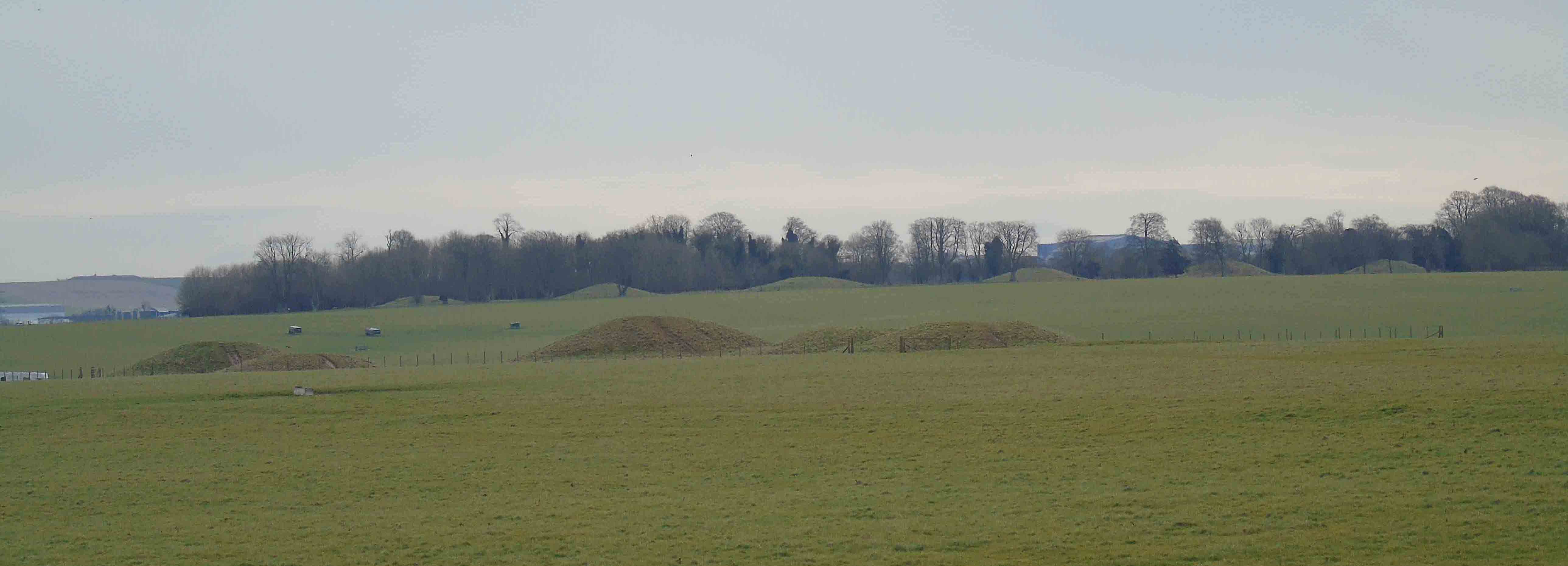 The King Barrows behind the Cursus Barrows – viewed from the north side of the west end of the Great Cursus in the Stonehenge landscape
The Stonehenge landscape has the richest concentration of Bronze Age burial mounds in Britain. If you cannot afford to visit Stonehenge itself, do not worry; most of the exciting landscape is managed by the National Trust and is free for you to explore.
After a recent early morning visit to Stonehenge, I walked back over the surrounding landscape to the Stonehenge Visitor Centre via the ‘Cursus barrows’ and Fargo Plantation.
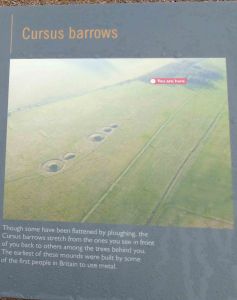 Aerial photograph of the Cursus Barrows from one of the heritage boards
The Cursus barrow group are a striking linear arrangement of Early Bronze Age burial mounds prominently situated on the north-western skyline when viewed from Stonehenge. They run for c. 1200m along the roughly W-E ridge located south of the west end of the Stonehenge…
View original post 227 more words
Rare Saxon coin comes home to Wiltshire
A RARE Saxon coin found in a field near Pewsey has just gone on show at Wiltshire Museum in Devizes after a public appeal raised the cash to buy it.
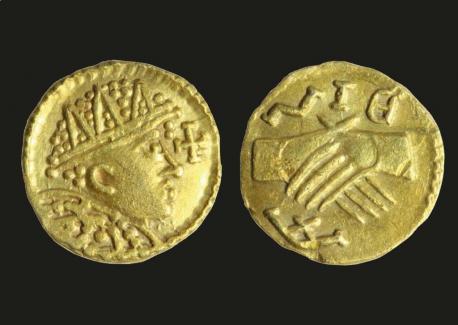
Saxon coin now back in Wiltshire (58503866)
The tiny gold coin which was bought for £18,000 at an auction in London in December is now displayed under a magnifying glass so visitors can see its full splendour.
Members of the museum celebrated the return of the coin to Wiltshire with a reception last Thursday complete with Mark Routledge dressed as a Saxon warrior.
Museum director David Dawson this week spoke of the anxious moment he spent on the phone bidding for the coin that was found in a field at East Grafton.
He said: “It was incredibly nerve wracking. I was very pleased to get it for £18,000. To be honest we would have paid a bit more. But you never know if there is going to be a private collector who is willing to pay whatever they have to get something they really want.
“I was shut away in my office during the bidding but the whole museum must have heard my whoops after I made the final bid and secured it. We are delighted to now have the coin on show.”
The coin which dates from AD 675 was originally thought to have been French but it has now been confirmed that it was minted in Kent.
At the time of the auction at Spinks in London Mr Dawson said: “We are delighted to have secured this important coin to be displayed at the Wiltshire Museum. It is a powerful demonstration of the importance of the Vale of Pewsey and the Kingdom of Wessex.
“We are very grateful to the almost 50 people from Wiltshire and across the world who have supported the purchase of this important coin, along with the help of our grant funders.”
The museum was awarded grants towards the purchase by the Arts Council England, the Victoria and Albert Purchase Grant Fund and the Art Fund.
In addition, donations and pledges were given through a fundraising appeal launched by the museum.
The coin dates to the time of the beginnings of Christianity in Wiltshire and just after the burial of King Raedwald at Sutton Hoo.
Mr Dawson said the remarkable find shed new light on the Vale of Pewsey in the Saxon period. East Grafton was part of the parish of Bedwyn until medieval times.
There are a number of pagan Saxon cemeteries nearby and there was an early Saxon Royal manor at the Iron Age hill fort at Chisbury, just to the north of Great Bedwyn.
Later in the Saxon period, the focus moved to Great Bedwyn where there was a Royal Manor and an important Minster church. Bedwyn was held by King Alfred and it also had a Saxon mint in the time of King Edward the Confessor soon after 1,000 AD.
Bedwyn was very important and it was only with the building of its Norman castle that the focus moved to Marlborough.
Stephen Deuchar, director of the Art Fund, said: “We are delighted that Wiltshire Museum was successful in acquiring at auction such an important coin.
He said: “Very few coins of such quality exist, and we are pleased to have played a role in ensuring that this beautiful example can remain forever in the very locality in which it was found.
“It’s a wonderful addition to the museum’s collection.”
Article source: Joanne Moore / / Gazette and Herald News
The Stonehenge Travel Company
Stonehenge and Salisbury Guided Tours

