Home » Uncategorized (Page 7)
Category Archives: Uncategorized
Major archaological find in the Vale of Pewsey, Wiltshire: metal detectors’ Roman hoard gives up rare evidence about ancient plant life
Mick Rae, Rob Abbott and their friend Dave were detecting in a field in the Vale of Pewsey in October 2014 when they came across a hoard of eight metal vessels – including a cauldron and four small pans from weighing scales.
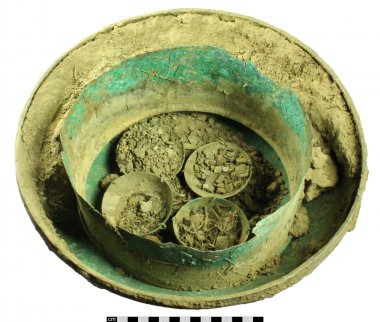
Cauldron showing scale pans [Photo copyright Portable Antiquities Scheme]
The find was quickly identified as Roman. The discovery was reported to Richard Henry who is Wiltshire’s Finds Liaison Officer. His role is to record archaeological finds made by members of the public – mostly metal detectorists, but also by people who are just walking in fields or digging in their back garden.
Most of the cauldron survives and a large copper-alloy vessel had been placed upside down into the cauldron – forming a sealed cavity. What was inside?
There were no gold necklaces or bronze coins in this hoard of Roman vessels. But what was found inside is worth its weight in gold to archaeologists – remains of plants preserved by the copper vessels’ own micro-environment.
Among the remains of the dried plants were heads of common knapweed and pieces of bracken. They also found seeds of cowslips or primrose, milkwort, lesser hawkbit, sedges, clovers, vetches and sweet violet, fat hen, knot grass, black bindweed, buttercup and corn spurrey. They may be what is left of some careful packing.
Remains of the flowers and bracken are now on display at the Wiltshire Museum in Devizes. Organic matter never survives if buried unprotected in the Pewsey Vale’s greensand – so to find dried plants and pollen this old provided the scientists with many opportunities for research.
The find did not count as ‘treasure’ so remains the property of the finder and the landowner. The detectorists donated the organic material to Wiltshire Museum – the scientific processes used to test it with would ultimately destroy it.
Richard Henry led the quest to discover more about the find. He brought in a team to excavate the site of the discovery, led by David Roberts of Historic England with the Assistant County Archaeologist, members of the Wiltshire Archaeology Field Group and the finders. They found shards of domestic and imported ceramics and ceramic building materials.
The project to analyse the plant remains has been led by the British Museum’s Portable Antiquities Scheme and supported by Historic England, Southampton University, the Association for Roman Archaeology and Wiltshire Museum.
The scientists discovered that the plants were dated between AD380 and AD550. They

Some of the flower heads from the hoard [Photo Steven Baker at Historic England – their copyright]
But if the age in years is a little speculative, the state of the plants reveals pretty accurately that they were picked and packed away in late summer soon after the harvest – late August to early October.
When their own kind of Brexit happened, the Romans obviously left much more behind them than roads, mosaics, villas and hoards of coins.
Wiltshire Museum’s Director, David Dawson, is thrilled they can display this important material: “Richard Henry has led this remarkable partnership project, drawing specialists from across the country to piece together the fascinating story of the burial of Roman bronze cauldrons that took place on a summer’s day 1,500 years ago.”
Richard Henry said “Such discoveries should be left in situ to allow full archaeological study of the find and its context. The finders did not clean or disturb the vessels which has allowed us to undertake detailed further research. If the vessels had been cleaned none of this research would have been possible.”
It is very tempting to imagine how this hoard came to be made so long after the vessels were first used. It is as though someone today decided to bury the Victorian kitchen pots Aunt Bertha inherited – and packed them with plants.
Why they were buried remains a matter for speculation. Does the careful packing of the metal vessels mean they were the antiques of their day? Were they, so long after the Roman era, still valued as useful cooking pots? Or was this some kind of votive offering?
Marlborough.News understands that metal detector Dave aims to have the vessels professionally conserved.
Ruth Pelling and Stacey Adams will be talking about their research on the flowers and other recent Wiltshire discoveries at the Archaeology in Wiltshire Conference on April 1 in Devizes. Their talk is titled “Bake Off and Brewing in Roman and Early Saxon Wiltshire: recent archaeobotanical finds.”
Article written by Written by Tony Millett and published on the Marlborough News Online Website
Join us on a guided tour from Salisbury and explore hear more about the recent archaeological discoveries.
Stonehenge and Salisbury Guided Tours
The Stonehenge Travel and Tour Company
http://www.StonehengeTravel.co.uk
Roman bronze pots and pans buried with flowers

 Here’s another great story from the new British Archaeology, which went live online today (February 8). Conservation of a hoard of late Roman bronze pots and pans found near Pewsey, Wiltshire, has revealed they were packed with plants, among which were bracken and knapweed flowers.
Eight mostly plain vessels had been carefully nested inside each other. There’s a bit of tinning on some of them, so I coloured the diagram silver rather than a reddish bronze.
The plants gave a rare radiocarbon date for a hoard, of AD380–550, placing its burial most probably in post-Roman (after AD410) or Anglo-Saxon times. It may be contemporary with a nearby early Anglo-Saxon cemetery at Blacknall Field.
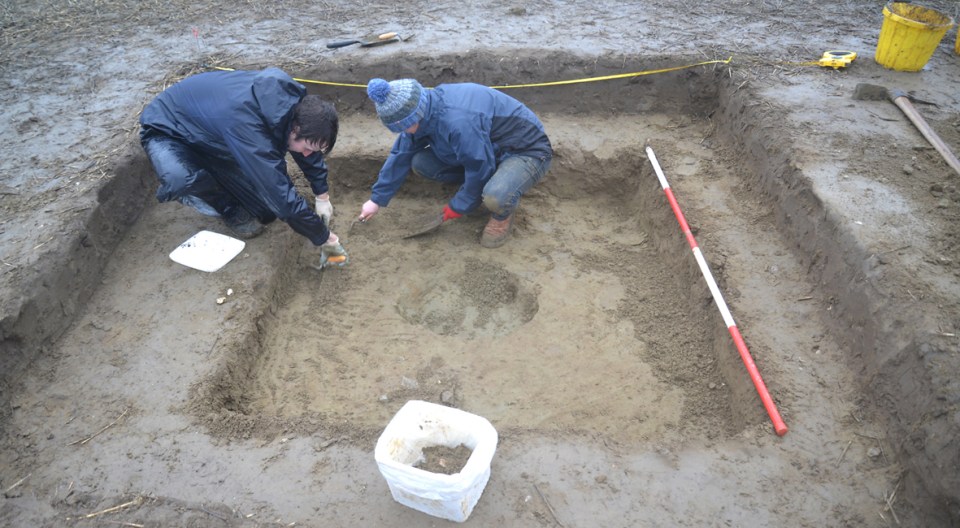 Richard Henry, Wiltshire finds liaison officer, and Rachel Foster, assistant county archaeologist, excavating the hoard site in 2014. Photo Past Landscapes Project
Three men and a woman with metal detectors made the discovery in late 2014 (Tony…
View original post 169 more words
Other Sarsen Stones near Stonehenge and Woodhenge

Sarsen boulders lie scattered in substantial “drifts” across the landscape of the Marlborough Downs near Avebury.
By contrast, close to Stonehenge there are almost none. This is one of the reasons why most archaeologists believe that the large sarsens for the monument were not locally sourced.
There are, however, a few examples of substantial sarsens dotted about Salisbury Plain within a couple of miles of Stonehenge. And there are tantalising hints that others used to exist.
The most obvious, and easily accessible, is the Cuckoo Stone. This stone is about 2m long by 1.5m wide by 1.5m thick and lies in the field immediately west of Woodhenge.

The Stonehenge Riverside Project excavated around the Cuckoo Stone in 2007 and discovered that the stone once had been set upright right next to the hollow in which it had originally formed.
Close by were two neolithic pits containing pottery worked…
View original post 805 more words
Current Archaeology Awards 2017. Rethinking Durrington Walls: a long -lost monument revealed.
The 9th annual Current Archaeology Awards celebrate the projects and publications that made the pages of CA this year, and the people judged to have made outstanding contributions to archaeology. Research Project of the Year category includes;
Rethinking Durrington Walls: a long-lost monument revealed
(CA 320 – Stonehenge Riverside Project / Stonehenge Hidden Landscapes Project / National Trust)
Ongoing research at Durrington Walls has revealed a massive and previously unknown palisaded enclosure beneath the banks of the famous Neolithic henge. It is a discovery that is set to rewrite the site’s history.
To cast your vote, click here!
Voting closes 6 February 2017
Durrington Walls, two miles from Stonehenge, is named after the Neolithic henge that calls the location home. But with ongoing research revealing a massive and previously unknown monument hidden beneath its banks, the site’s history is set to be rewritten. Carly Hilts spoke to Vince Gaffney, Mike Parker Pearson, and Nick Snashall to find out more.
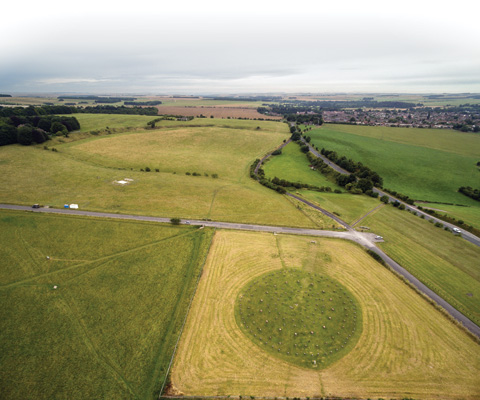
Looking towards Durrington Walls henge, over the concentric rings of posts that mark Woodhenge. Ongoing research has revealed huge post holes (inset) belonging to another wooden monument hidden beneath the prehistoric bank.
Around 4,500 years ago, hundreds of people gathered two miles from Stonehenge to build another massive monument, at a location known to us as Durrington Walls. The spot they had selected lay within sight of the celebrated stones, and had previously been home to a village that may have housed the community that erected them (CA 208). But now the short-lived settlement lay abandoned, and – perhaps motivated by a desire to commemorate its presence – the new group of builders punched through the living surfaces and midden material of their predecessors to complete their work.
Their efforts were not focused on raising the imposing earthworks of the henge that gives the site its modern name, however. Instead, their labour created a previously unknown earlier phase whose full extent is only now being revealed by ongoing research: as many as 300 huge wooden posts, evenly spaced 5m apart in a ring almost 450m across. It would have been an arresting sight, yet within a maximum of 50 years the monument had been decommissioned once more, its posts removed and their sockets filled in, before being covered over by the henge that we see today. All trace of the post circle would lie hidden beneath the banks of its successor for millennia – until it was brought to light once more by a series of excavations and the largest geophysical survey of its kind. Why did the site undergo such a sudden change in design, and what can we learn about the rise and fall of a long-lost monument? As analysis continues, intriguing clues are beginning to emerge.~
Full story here
Join the local Stonehenge experts on a guided tour from Salisbury and hear all about this amazing discovery.
Stonehenge and Salisbury Guided Tour
The Stonehenge Travel Company
http://www.StonehengeTravel.co.uk
Woodhenge Henge Timber Circle – Amesbury, Wiltshire. A wooden version of Stonehenge?
“A little further on the right of the road leading to Amesbury, we see the mutilated remains of an enormous Druid barrow”
This is how Richard Colt Hoare described Woodhenge in the early 19th century, and it continued to be viewed as a disc barrow (with the name “Dough Cover”) until 30th June 1926.
On that day, Squadron Leader Gilbert Insall VC took an aerial photograph that showed a series of dark circular cropmarks inside the area enclosed by what had been regarded as the barrow’s ditch.
Insall’s photo is shown below, Woodhenge is just above left of the centre.
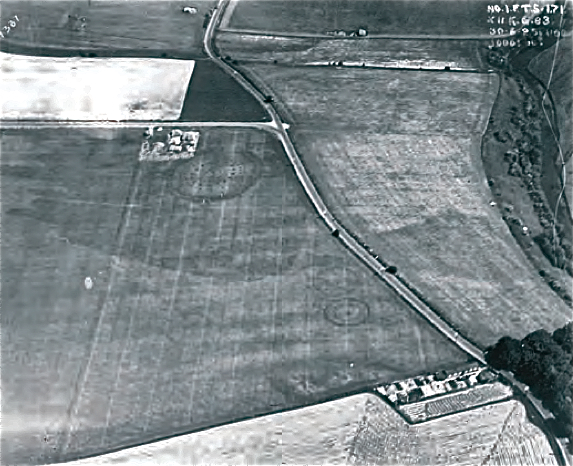
These marks later proved to be the surface traces of six concentric rings of postholes, uncovered by Maud and Ben Cunnington in their excavations between 1926 and 1928. These posts date to between 2600 and 2400BC.
When their excavations were over, they installed short concrete markers to show…
View original post 683 more words
The Blick Mead excavations have transformed the understanding of the Stonehenge landscape.
In the early 2000s, Professor David Jacques was researching the estate records of Amesbury Abbey and realised that the archaeology around the Iron Age hillfort known as Vespasian’s Camp had probably not been obliterated by landscaping of the parkland in the 18th Century, as had previously been assumed.
The subsequent excavations, from 2005 onwards, around the spring pool at Blick Mead have transformed the understanding of the Stonehenge landscape.
 Archaeologists at the University of Buckingham, led by David Jacques found the ancient site in October 2014, which is around one-and-a-half miles (2.4km) from Stonehenge
The earliest datable “monumental” activity at Stonehenge comes from pine charcoal found at the bottom of two of the three enormous post pits that were discovered in the late 1960s when the old car park was being extended.
Radiocarbon-dated to around 7,500 – 7,900 BC these almost 1m diameter pine posts were erected back…
View original post 730 more words
2017 Stonehenge Private Guided Access Tours departing from Salisbury
Be one of the few people to walk amongst the inner stone circle at Stonehenge on our exclusive special access trips.
What better way to experience the magic and mystery of Stonehenge than with a private viewing at sunrise or sunset. On our popular exclusive private guided tours from Salisbury, guests will be able to access the historic stone circle, and explore the surrounding area rich in history, myths and legends. We are proud to be the longest established Stonehenge Tour Company operating the very 1st special access tours into the monument. Please view our exclusive Stonehenge inner circle tours

“Being able to walk amongst the stones at dawn without the crowds and without the rope barrier is a truly magical experience”
Our exclusive entry into the stone circle allows you to wander in and around the heritage site and experience an up close and personal look at this iconic monument. We have scheduled small group tours and arrange custom private tours. Please visit our travel website for details.
Stonehenge at Sunrise or Sunset
In the evening after Stonehenge is closed to the public, or at dawn before it is open, we can arrange for you to visit this awe-inspiring prehistoric monument and walk among the giant sarsen stones towering 6.4 m high and weighing up to 50 tonnes. Marvel at how stones of such monumental scale were quarried, transported and erected 5,000 years ago when the only tools available were made of wood, bone and stone.
For those of you who have not visited Stonehenge, we should mention that the complex is roped off. Visitors observe the stones from a distance and are not permitted within the Stone Circle which can be somewhat frustrating. Our private special access tours allow you to be amongst the stones.
Please follow us on Twitter for all the latest Stonehenge and Salisbury tourism news and Instagram for Stonehenge and Wiltshire photos.
Stonehenge and Salisbury Guided Tours
www.StonehengeTravel.co.uk
Approve Visit Wiltshire Member
8 Images of a Frosted England

Baby, it’s cold outside!
Our Archive collection of over 9 million images is a window into the history of England’s archaeology, historic buildings and social history. You can use the archive to learn about your local area, and research well known historic buildings and sites. We hold some of the earliest photography ever taken.
Keep warm this winter with our pick of 8 archive images of the historic environment covered in a blanket of snow:
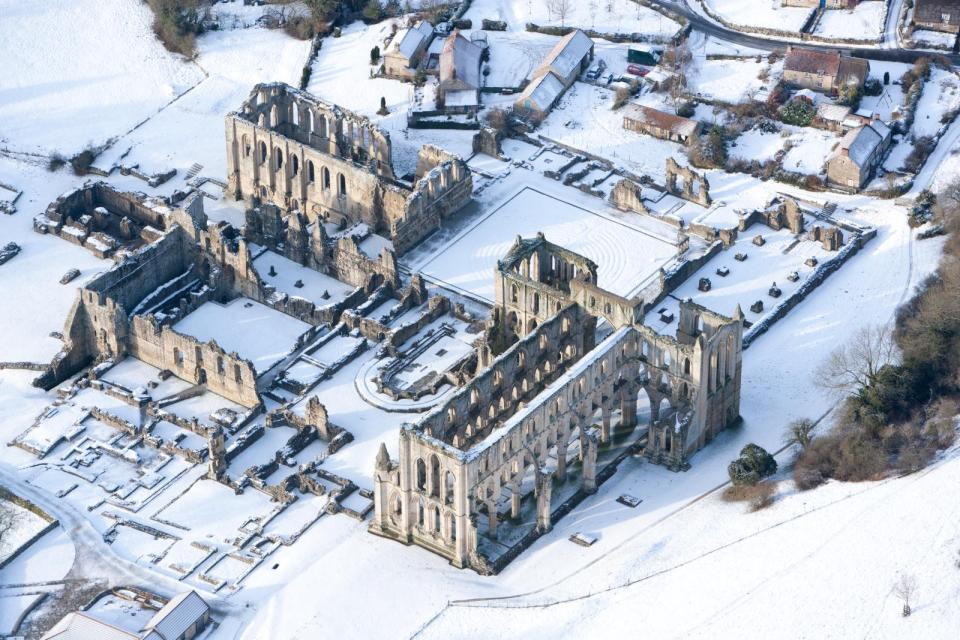
1. Rievaulx Abbey, Ryedale, North Yorkshire
 © Historic England
At one time one of England’s most powerful Cistercian monasteries, the impressive ruins of Rievaulx Abbey is managed by English Heritage and is Grade I listed.
2. Highgate Cemetery, London
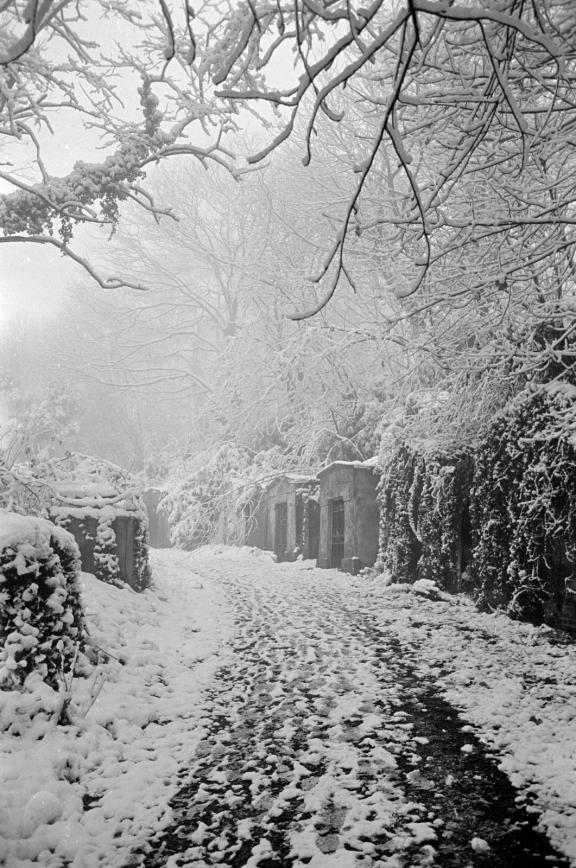 MF001673/09 © Historic England
The resting place of many famous residents and the home of some of the finest funerary architecture in the country, Highgate Cemetery is Grade I listed on the Register of Parks and…
View original post 310 more words
Virtual Reality Helps Scientists Recreate The Sounds Of Stonehenge
Stonehenge may have been a centre of ritual musical activity.
A team of researchers has borrowed technology from the architectural and video games industries to bring the ruins of Stonehenge to life. The end product of the group’s endeavours is a virtual reality tour of the ancient site that recreates what it what have looked and sounded like several thousand years ago.
Though the purpose and origins of Stonehenge are still shrouded in mystery, researchers such as Rupert Till from the University of Huddersfield believe it probably served as a venue for ritual musical activity.
Mathematical reconstructions of the site and its acoustics have indicated that it may once have been capable of resonating at low frequencies when the wind blew or when percussive instruments were played within the circle of stones. Till and his colleagues suggest that the brainwaves of those present may have become synchronized with these frequencies – a phenomenon known as entrainment – in order to generate altered states of consciousness and even send people into a kind of trance.
Unfortunately, many of the stones have been eroded or removed over the past few millennia, so experiencing this first-hand is no longer possible. Yet the new virtual reality reconstruction of the site offers the next best thing, by digitally recreating the sights and sounds of Stonehenge as it was back in its heyday.
Join us on a Stonehenge Private Access Tour from Salisbury and hear all tthe latest theories from our local expert guides.
Stonehenge and Salisbury Guided Tours
The Stonehenge Travel Company
http://www.StonehengeTravel.co.uk
The lost sounds of Stonehenge. Hidden sounds of prehistoric site revealed on new app
There are many questions surrounding the ancient stone circle of Stonehenge but might sound help in the search for answers?
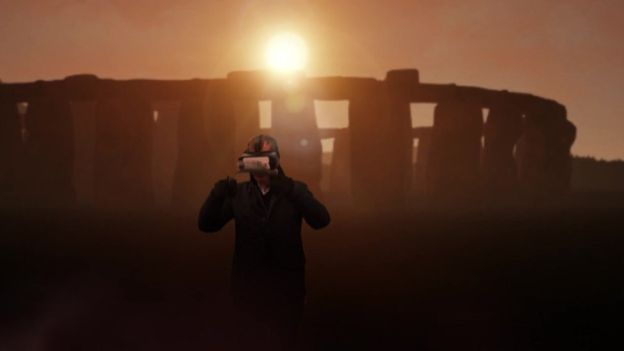 Virtual reality allows new ways to examine Stonehenge’s history
Thomas Hardy said it had a strange “musical hum”. Tess of the d’Urvbervilles ends at Stonehenge and features the “sound”. Modern-day druids also say they experience something special when they gather at Stonehenge and play instruments within the stone circle.
However, Stonehenge is a ruin. Whatever sound it originally had 3,000 years ago has been lost but now, using technology created for video games and architects, Dr Rupert Till of the University of Huddersfield has – with the help of some ancient instruments – created a virtual sound tour of Stonehenge as it would have sounded with all the stones in place.
Arriving at 07:00 on a decidedly chilly January morning, I was sceptical. Dr Till had arrived with a…
View original post 465 more words

