Home » Posts tagged 'Stonehenge' (Page 3)
Tag Archives: Stonehenge
English Heritage has opened five recreated Neolithic houses, in the shadow of Stonehenge.
The recently built Neolithic houses built by volunteers next to the new Stonehenge visitor centre have proved popular with tourists. Overseas visitors have found them fascinating. This recent international article in Newsweek gives an indepth insight:
Stonehenge Reconstructions Show Brits Have Always Been Houseproud
English Heritage has opened five recreated Neolithic houses, in the shadow of Stonehenge, revealing how the builders of the monument lived 4,500 years ago. At first glance, we could be forgiven for thinking they were built in the modern age. Certainly, their building techniques are very similar to those used on Victorian cottages in nearby Wiltshire villages. The walls were made from cob, a mixture of the local chalk and hay, slapped, when wet, onto seven-year-old hazel stakes. These walls were then topped with thatched roofs, made from knotted straw tied onto a woven hazel frame.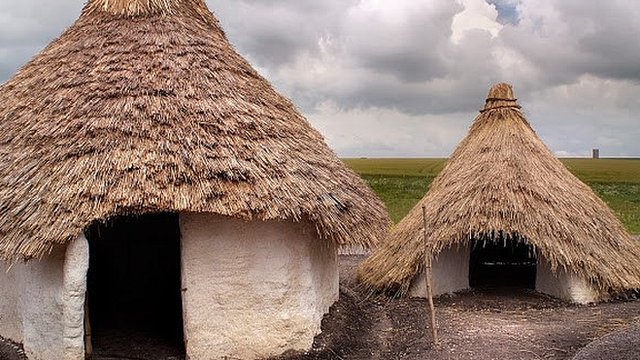
Far from being dark, little Hobbit spaces, the interiors are surprisingly bright, illuminated by the white chalk walls and floors, and open door. A tall man can easily stand up straight inside. In the middle of the room, the ash-log fire on the hearth sends up smoke, which seeps through the thatch. As the smoke slowly dissipates, it creates a thin carbon dioxide layer against the straw that stops any spark from the fire igniting the thatch. As if that weren’t ingenious enough, the thatch expands in the rain, providing an even more waterproof membrane.
The houses are pretty small – around 5m across – but they were certainly big enough to hold a family: English Heritage has managed to fit in 15 people easily into a single house, gathered around the fire.
It wasn’t just the architecture that was astonishingly avant-garde. Furniture in 2,500 BC, when Stonehenge and these cottages were thought to have been built, was pretty advanced too. Neolithic man slept on animal skins on wooden beds, with cupboards and shelves carefully inserted into the wall. In the house and outside the front door, there were handy pits, filled with handsome, striped pottery, known as “grooved ware”, the first pottery in Britain with a flat base. The pits also contained a selection of flints and animal bones, carved to create every conceivable mod con. Near Stonehenge, archaeologists have found chalk axes, bone tweezers, flint awls for piercing holes in bone and leather, flint saws and flint “fabricators” to create sparks for igniting fires.
The beauty of these objects – and the advanced engineering of the houses – seems particularly astonishing when we consider how early on in European, and global, civilisation they were made. In 2,500 BC, the Great Pyramid was being built at Giza, in Egypt. It was 500 years before the Minoan civilisation flourished at the Palace of Knossos; 900 years before the Mycenean civilisation in mainland Greece; and 2,000 years before the Parthenon was constructed. Jesus Christ is 500 years closer to us today than he was to the people who lived in these houses
Constructed over five months by 60 English Heritage volunteers, the buildings were closely based on the remains of Neolithic houses discovered in 2006 and 2007 at Durrington Walls, a ceremonial earthwork enclosure just north-east of Stonehenge. Radiocarbon dating has placed that settlement at about the same time that the mammoth sarsen stones from north Wiltshire, and the smaller bluestones from south Wales, were being raised at Stonehenge. So they’re among the earliest houses ever found in Britain.
Just like those nearby Wiltshire villages today, Durrington Walls consisted of a series of these cottages – and there may be 100s more, yet to be found – clustered closely together, but separated by woven wooden fences.
Again like lots of modern villages, Durrington Walls was built next to the River Avon – a crucial water source, home not just to trout and salmon, but to beavers and otters, much prized for their fur. Edible plants grew in the nearby damp soil, and red deer came to drink at the water’s edge. Deer antlers were used both as pickaxes and rakes to build the ditch and banks that circle Stonehenge. One red deer antler pick was found, laid carefully right on the floor of the ditch, perhaps to celebrate the end of the work.
The Flintstone diet wasn’t so different to ours, either: surviving cow and pig bones, some of them still with butchering marks on them, reveal a meat-rich diet, although there’s little trace of any cereal grain.
Already at this early stage, there are plenty of signs of human migration by water, too. The Amesbury Archer – whose burial was discovered in 2002, 5km east of Stonehenge – was born in the Alps, probably in what is now Switzerland. His origins were found thanks to chemical analysis of his teeth. The Amesbury Archer is thought to have been buried in 2,400 BC, a century after Stonehenge was built.
His body was surrounded by a glittering array of treasures: three copper knives, 16 flint arrowheads and a pair of gold hair ornaments, the earliest gold found in Britain. He was also buried with two archers’ stone wrist-protectors, which gave him his moniker. Alongside him, there were five delicately-carved and shaped Beaker pots, which gave their name to the neolithic Beaker culture, which spread right across western Europe, from present-day Holland to Spain, France and Germany.
The more archaeological research is made into Stonehenge man, the more evidence emerges that Britain wasn’t some remote backwater in the Neolithic Age, waiting for the Romans to provide it with the basics of civilised life. In the new Stonehenge visitors’ centre, hidden in a fold of Salisbury Plain close to the stones, there stands the skeleton of another early Neolithic Briton – whose recent bone analysis reveals quite how advanced this supposedly primitive civilisation was. The skeleton – excavated from a long barrow at Winterbourne Stoke, 3km west of Stonehenge – belonged to a man active in 3,000 BC, when the first earthwork enclosure at Stonehenge was built. Examining the enamel in his teeth – and the levels of strontium and oxygen, elements which vary in quantity from location to location – archaeologists have determined that he was probably born in Wales, moved to Wiltshire at two, went back to Wales at nine, and then shuttled between Stonehenge and Wales from 11 to 15. These regular journeys might explain the Welsh bluestones at Stonehenge – they were religious and sentimental reminders of the old country. This Neolithic man wasn’t so different from us. He was 1.72m, only 25mm shorter than the average British male today. He was 76kg, and lived off a classic West Country diet of dairy products and meat – mostly beef, mutton and venison.
Dr Simon Mays, the English Heritage scientist who carried out the bone analysis, determined that he’d led a peaceful life, with no injuries apart from a damaged knee ligament and a torn back thigh muscle. There was no sign of any illness, disease or nutritional stress in the body. He seems to have died in his late 20s or 30s. Life expectancy was a lot shorter, then, but what’s clear is that the great British obsession – class – was already alive and well 5,500 years ago. Our man was buried in one of the area’s grandest mausolea – and was initially the only body there, until he was joined around a thousand years later by other bodies in less prominent spots in the 82m-long grave.
There are around 350 of these long barrows in Britain. Half of them had no one buried in them at all; another quarter had five to 15 people in them; and only a quarter were allotted to a single person. So we are dealing with a major toff here, moving between his various smart residences in Wales and Wiltshire. A second home for the rich is nothing new.
The Durrington Walls houses may also help unlock one of the great secrets of mankind -–what was Stonehenge actually for? No one can be definitively sure but one of the most popular current theories is that it was a sort of holy cemetery. Its circles of cold stone, with cremated human bones all around, have been called “the land of the dead”. This is contrasted with “the land of the living” – with the timber houses of Durrington Walls, next door to another circular monument, Woodhenge, also built out of timber. Just walking around the Neolithic houses, we begin to see why this part of the West Country is so rich in Neolithic and Bronze Age finds. Not only is the open, rolling country so well-suited to farming – as it still is today – but also it’s purpose-built for house construction.
As visitors stroll around Stonehenge, they still kick up great lumps of chalk, studded with fragments of flint – the same chalk that built those ancient houses, the same flint that lit those long-extinguished ash fires. Suddenly, the Stone Age doesn’t seem so far away.
Stonehenge Reconstructions Show Brits Have Always Been Houseproud
http://www.newsweek.com/2014/06/20/meet-flintstones-265268.html
Before Stonehenge – did this man lord it over Wiltshire’s sacred landscape?
Archaeologists have just completed the most detailed study ever carried out of the life story of a prehistoric Briton
What they have discovered sheds remarkable new light on the people who, some 5500 years ago, were building the great ritual monuments of what would become the sacred landscape of Stonehenge.
A leading forensic specialist has also used that prehistoric Briton’s skull to produce the most life-like, and
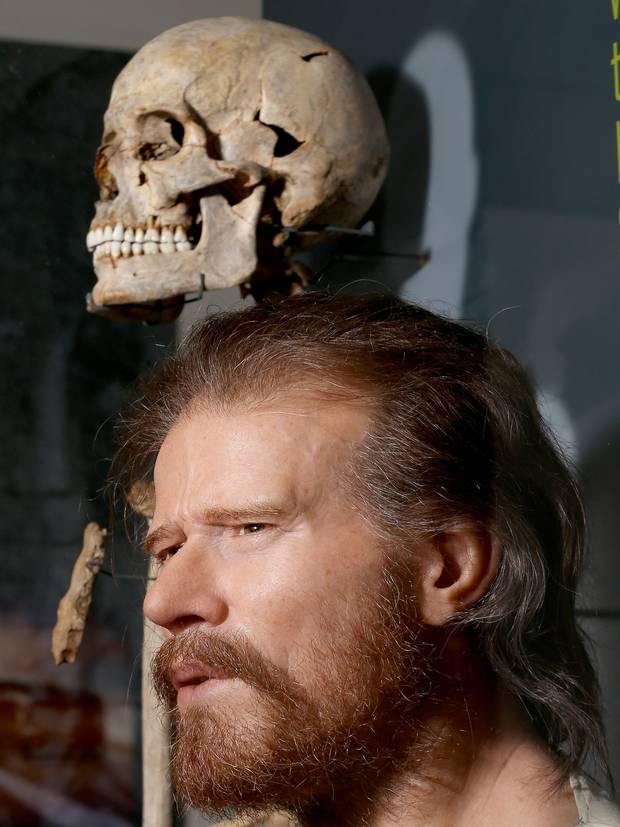
How 21st-century science is recreating the life story of a neolithic leader – what he looked like, where he grew up and what he ate
arguably the most accurate, reconstruction of a specific individual’s face from British prehistory.
The new research gives a rare glimpse into upper class life back in the Neolithic.
Five and a half millennia ago, he was almost certainly a very prominent and powerful individual – and he is about to be thrust into the limelight once again. For his is the prehistoric face that will welcome literally millions of visitors from around the world to English Heritage’s new Stonehenge visitor centre after it opens tomorrow, Wednesday. The organisation estimates that around 1.2 million tourists from dozens of countries will ‘meet’ him as they explore the new visitor centre over the next 12 months.
The new scientific research has revealed, to an unprecedented degree, who this ‘face of prehistory’ really was.
He was born around 5500 years ago, well to the west or north-west of the Stonehenge area, probably in Wales (but conceivably in Devon or Brittany)
Aged two, he was taken east, presumably by his parents, to an area of chalk geology – probably Wiltshire (around the area that would, 500 years later, become the site of early Stonehenge). However, aged 9, he then moved back to the west (potentially to the area where he had been born) – and then, aged 11, he moved back east once more (again, potentially to the Stonehenge area).
Aged 12, 14 and 15, he travelled back and forth between east and west for short durations and at increased frequency. Scientists, analysing successive layers of the enamel in his teeth, have been able to work all this out by analysing the isotopic values of the chemical elements strontium (which changed according to underlying geology) and oxygen which reflected the sources of his drinking water.
He grew into a taller than average man, reaching an adult height of 172 centimetres. In Neolithic Britain, the average height for adult males was 165 centimetres, while in Britain today it is 176. He probably weighed around 76 kilos (12 stone) and had fairly slender build. Throughout his life, he seems to have consumed a much less coarse diet than was normal at the time . His teeth show much lighter wear than many other examples from the Neolithic. He also had a much higher percentage of meat and dairy produce in his diet than would probably have been normal at the time.
By analysing nitrogen isotope levels in his teeth, a scientific team at the University of Southampton, led by archaeologist Dr Alistair Pike, have worked out that he obtained 80-90% of his protein from animals – probably mainly cattle, sheep and deer.
A detailed osteological examination of his skeleton, carried out by English Heritage scientist, Dr Simon Mays, has revealed that he probably led a relatively peaceful life. The only visible injuries showed that he had damaged a knee ligament and torn a back thigh muscle – both injuries, potentially sustained at the same time, that would have put him out of action for no more than a few weeks.
There is also no evidence of severe illness – and an examination of hypoplasia (tooth enamel deformation) levels suggest that at least his childhood was free of nutritional stress or severe disease. Hypoplasia provides a record of stress through a person’s childhood and early teenage years.
But he seems to have died relatively young, probably in his late 20s or 30s. At present it is not known what caused his death.
However, he was probably given an impressive funeral – and certainly buried in a ritually very important location.
Initially his body was almost certainly covered by a turf mound but some years or decades later, this mound was massively enlarged to form a very substantial mausoleum – one of the grandest known from Neolithic Britain. He was the only individual buried there during his era – although a thousand or more years later, several more people were interred in less prominent locations within the monument.
This great mausoleum – 83 metres long and several metres high – was treated with substantial respect throughout most of prehistory – and can still be seen today some one and half miles west of Stonehenge. Fifteen hundred years after his death, his tomb became the key monument in a new cemetery for the Stonehenge elites of the early Bronze Age.
All the new evidence combines to suggest that he was a very important individual – a prominent member of the early Neolithic elite.
The research into his life has yielded a number of fascinating new revelations about that period of British prehistory.
First of all, it hints at the degree to which society was stratified by this time in prehistory. Far from being an egalitarian society, as many have tended to think, the evidence points in the opposite direction. Most early Neolithic people were not given such grand mausolea . The type of monument which was constructed over his grave (known to archaeologists as a long barrow) was primarily a place of ritual, not just a place associated with burial. By having one erected over him, he was being given a very special honour.
Of the 350 such long barrows known in Britain, it is estimated that 50% had no burials in them at all, that a further 25% had just one person buried in them – and that most of the remaining quarter had between five and 15 buried in each of them.
Secondly, it shows, arguably for the first time, that high social status in the early Neolithic was already a matter of heredity. The isotopic tests on the man’s teeth show quite clearly that his privileged high meat diet was already a key feature in his life during childhood.
Thirdly, the scientific investigation suggests that at least the elite of the period was associated with a very wide geographical area. In other words, they were not simply a local elite but, at the very least, a regional one. The fact that he seems to have moved back and forth between the west of Britain (probably Wales) and the southern chalklands (probably the Stonehenge area) every few years, at least during his childhood and teenage years, suggests that his family had important roles in both areas.
Given the ritual significance of the Stonehenge area, even at this early stage, it is possible that he and his father and other ancestors before him had been hereditary tribal or even conceivably pan-tribal priests or shamans in a possibly semi-nomadic society. It is also likely that such people also played roles in the secular governance of emerging political entities at the time.
Most tantalizing of all, is the newly revealed likely link between Wales and the pre-Stonehenge ritual landscape. When the first phase of Stonehenge itself was finally built in around 3000 BC, the stones that were probably erected there were not, at that stage, the great sarsens which dominate the site today, but were probably the much smaller so-called ‘bluestones’ (some of which are still there).
Significantly, it is known from geological analysis that those bluestones originally came from south-west Wales – and were therefore almost certainly brought from there to Stonehenge by Neolithic Britons.
Indeed, as late as the 12th century AD, the Anglo-Norman chronicler, Geoffrey of Monmouth, wrote down an ancient legend also suggesting that the stones had come from the west (albeit, in his account, from Ireland, rather than Wales). Archaeologists will now be investigating whether the Stonehenge landscape’s link with Wales was in reality even older than that first phase of the monument.
In that sense it is spookily relevant that the mid-fourth millennium BC man chosen by English Heritage to be the ‘face of the Neolithic’ may actually have been a key part of the original cultural process which ultimately, five centuries later, led to early Stonehenge being erected.
The new visitor centre – built with steel, wood and glass in ultra-modern style – tells the story of Stonehenge and its prehistoric ritual landscape and illustrates it with 300 mainly stone and ceramic artefacts from antiquarian and archaeological excavations carried out around the great stone monument over the past two centuries
David Keys: Archaeology Correspondent
Full article in the Independent: http://www.independent.co.uk/news/science/archaeology/before-stonehenge–did-this-man-lord-it-over-wiltshires-sacred-landscape-9008683.html
Stonehenge Travel Company
Stonehenge Guided Tours from Salisbury
Amesbury dig may unravel Stonehenge mysteries
Archaeologists have started a new excavation of Amesbury in an attempt to uncover some of the mysteries of Stonehenge. Amesbury is located in southern Wiltshire, England, and in recent years has revealed some incredible archaeological discoveries, including numerous monuments and artefacts dating back to the Mesolithic era. The major dig due to start soon could help to explain why Stonehenge was built where it was.
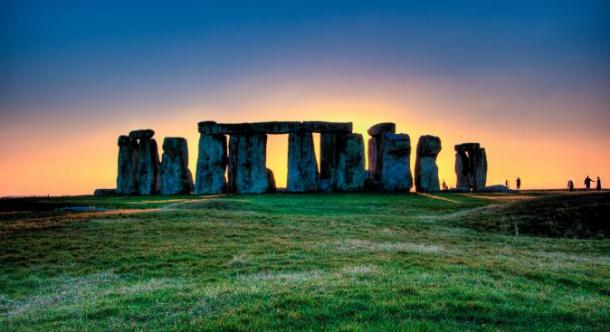 Excavations since 2005 have indicated that Amesbury and the surrounding area has been settled for around 10,000 years, much earlier than previous thought. Findings have included large scale prehistoric structures and settlements and numerous monuments around Stonehenge.
The last significant finding occurred at a site called Vespasian’s Camp, approximately 1 mile from Stonehenge, which showed traces of human settlement 3,000 years before nearby Stonehenge was apparently built. David Jacques, a researcher who has directed eleven small excavations between 2005 and 2012, has described the site as “potentially one of the pivotal places in the history of the Stonehenge landscape.”
New excavations will be seeking to establish Amesbury as the oldest continuous settlement in the UK. At the moment, neighbouring region, Thatcham, has evidence for the oldest settlement with well-preserved remains of a Mesolithic settlement dating back to 7,700 BC. In Amesbury, evidence of settlement has been found dating back to 7,596 BC, but archaeologists have not yet reached the bottom section of the trench where previous digs took place, indicating that much older evidence may be found beneath. The team is hoping to find evidence of settlement going back to 10,000 BC.
But the dig is about much more than establishing the oldest date of settlement. The team or archaeologists believe that findings may help to explain why Stonehenge is where it is.
“No-one would have built Stonehenge without there being something really special about the area, said Andy Rhind-Tutt from Amesbury Museum.” There must have been something there beforehand and Amesbury may well be it – [it could be] one of the greatest Mesolithic sites in the country.”
The dig will finish on 25th October and findings from the excavation will be reported then.
By April Holloway (http://beforeitsnews.com)
The Stonehenge Travel Company (www.StonehengeTravel.co.uk)
Stonehenge Guided Tours from Salisbury
Best attraction Award for Stonehenge
STONEHENGE has been rated as one of the UK’s best tourist attractions by customers of Irish bus tour operator, CIE Tours International.

Karin Gidlund, from CIE Tours International (centre left), hands over the award to Jon Bichener, Stonehenge retail manager (left) and Stonehenge property supervisors Anneka Harris (centre right) and Kevin Barber (right).
The award acknowledges customer satisfaction of 90 per cent or over, based on feedback from those visiting the ancient stones.
Peter Carson, head of Stonehenge for English Heritage, said: “We are so thrilled to have received this award given our current limited facilities, and therefore it is a real pat on the back for the high standards of service offered by our team to our customers.
With the completion of our new visitor facilities just a few months away we will be able to offer an even better welcome in the future.”
Full story in the Salisbury Journal: http://www.salisburyjournal.co.uk/news/10631514.Award_for_Stonehenge/
Stonehenge Travel Company, Salisbury
 Stonehenge and Salisbury Guided Tours