Home » Posts tagged 'Wiltshire' (Page 2)
Tag Archives: Wiltshire
Archaeology Day Tours of Wiltshire’s World Heritage Sites.
Stonehenge and Avebury form part of an UNESCO World Heritage Site which stands testament to the ages. The explanations behind why the sites are located where they are and what their exact purposes are still remain a mystery to this day with a magnetism that has drawn people to them for centuries.
We are pleased to offer exclusive Archaeology Tours visiting both Stonehenge and Avebury throughout 2016. We believe we offer an excellent up-to-date specialist service; giving you the opportunity to learn in great detail about these amazing prehistoric sites, but also leaving you time to explore your surroundings by yourself.
Stonehenge, Avebury and Bath Guided Tour from London
Britian’s most beautiful landscapes
Tour Leaders are qualified archaeologists
Walk the paths of ritual specialists and builders of Britain’s most fascinating and awe-inspiring prehistoric sites, at Stonehenge and Avebury.
Explore the Roman and Georgian history of Bath.
Guaranteed small groups 8 – 18 participants.
This feature-packed archaeological tour takes in the iconic stone circles of Stonehenge

Small Group Guided Tour of Avebury
and Avebury and a delightful break in the beautiful Roman city of Bath.
Leaving from London by luxury mini coach, this Stonehenge tour will explore its iconic standing stones with expert analysis by a trained archaeologist. Nearby Avebury is an even more impressive site, covering a much wider area and you will also encounter Neolithic burial tombs and the less visited ancient site of Woodhenge.
Mid-day is spent in gorgeous Bath offering history of a different era. There are colorful remnants of its glorious Roman past to see and regency mansion houses from Georgian times. The famous Roman baths are a must see.
Guided tour itinerary:
The morning starts with a visit to Durrington Walls and Woodhenge, home to the ‘Stonehenge Builder’s’ village and the most convincing evidence for human sacrifice. We then travel a short distance to Stonehenge. We enjoy a leisurely paced walk through the landscape immediately surrounding Stonehenge, visiting the Stonehenge Cursus, Bronze Age burial mounds and walk along the Stonehenge Avenue. We complete our morning at Stonehenge with a guided walk around the stone circle, our archaeologists bringing to life this enigmatic, ancient and mysterious monument.
At mid-day we arrive at the beautiful Georgian city of Bath. Here we allow our guests aprox 2 hours to enjoy the centre of this city, famous for Jane Austen, Bath Abbey and the Roman Baths. We also use this opportunity for our guests to have lunch.
We conclude our visit to Bath with a coach tour of the most impressive examples of architecture Bath has to offer, visiting the Assembly Rooms, Royal Circus and Royal Crescent.
The Afternoon is spent at the Avebury World Heritage Landscape. We visit Silbury Hill, the largest man-made hill in prehistoric Europe. We enter the 5500 year old burial chamber of West Kennet Long Barrow, entering a sacred space originally reserved only for ritual specialists and the dead.
We finish by visiting the largest stone circle in Europe at Avebury, with its beautiful medieval village situated inside. As John Aubrey in the 1600’s notes [Avebury]…”does as much exceed in greatness the so renowned Stonehenge as a Cathedral doeth a parish church.”
Please also note as part of the Stonehenge, Salisbury and Avebury Archaeologist Guided Tour, the detailed walk around the Stonehenge Cursus, Stonehenge Avenue and Bronze Age burial mounds only runs between March to October, this is due to time restrictions in the winter months
View 2016 Tour Departures and book now
We also offer a Stonehenge, Bath and Salisbury guided tour
Bringing History Alive……………..
Links:
STONEHENGE & AVEBURY WORLD HERITAGE SITE
VISIT WILTSHIRE WORLD HERITAGE SITE INFORMATION
Stonehenge and Salisbury Guided Tours
The Stonehenge Travel and Tour Company
http://www.StonehengeTravel.co.uk
950th Anniversary of the Battle of Hastings
Plans are under way to mark the 950th anniversary of the Battle of Hastings in the town linked to the most famous conflict in English history.
The events aim to mark the significance of the battle which altered the course of history in medieval England and led to the Norman Conquest.
William the Conqueror established a royal castle at Old Sarum (Salisbury, Wiltshire), in the middle of the earthworks, shortly after 1066. This, says English Heritage, transformed the site, effectively dividing the hillfort in two: an inner set of fortifications, which became William’s castle, and a huge outer enclosure, within which a cathedral was built in 1075

Here, we tell you everything you need to know about Old Sarum in Wiltshire…
1) Old Sarum is the site of the earliest settlement of Salisbury. It is two miles north of where the city now stands
2) The Romans, Normans and Saxons all left their mark there: Old Sarum was used as an Iron Age hillfort between about 400 BC and AD 43 – one of the largest in England – before being occupied shortly after the Roman conquest of Britain, when it became known as Sorviodunum. The Romans occupied the site until about AD 410.
William the Conqueror established a royal castle at Old Sarum, in the middle of the earthworks, shortly after 1066. This, says English Heritage, transformed the site, effectively dividing the hillfort in two: an inner set of fortifications, which became William’s castle, and a huge outer enclosure, within which a cathedral was built in 1075
3) The royal castle, created shortly after 1066, was “a major administrative centre”, says English Heritage. The sheriffs of Wiltshire were established in the castle, and the cathedral later provided a body of clerks who assisted with major projects
4) Old Sarum is historically important as the site of the Oath of Sarum of 1 August 1086. Facing revolt and invasion, William I [aka William the Conqueror] gathered the powerful, landholding men of the realm to a ceremony in which they swore allegiance to him. The ceremony, described by English Heritage as “a striking assertion of royal power”, underlined William’s position as the source of tenure of all land across England.
5) Between 1173 and 1189 Henry II’s queen, Eleanor of Aquitaine, was kept under house arrest at Old Sarum for having incited her sons to rebel against their father
6) The cathedral was demolished during the medieval period: dissatisfaction with the site and poor relations with the garrison in the castle caused the cathedral to be moved to its present site in Salisbury (New Sarum) in the 1220s. After this time, royal interest in the castle waned. English Heritage explains: “The castle seems to have limped on as an administrative centre into the 15th century, the end finally coming in 1514, when Henry VIII made over the ‘stones called the castle or tower of Old Sarum’ to Thomas Compton, together with the right to carry away the materials.”
7) Old Sarum lived on as a famous ‘rotten borough’ that continued to elect members of parliament until the Reform Act 1832. The parliamentary constituency had a very small electorate and could be used by a patron to gain unrepresentative influence within the unreformed House of Commons. Thomas Pitt became the owner of the site, and the votes attached to it, in 1691. Arguably, had it not been for this, Pitt’s famous grandson William might never have entered the House of Commons, because he first sat in parliament as a member of Old Sarum.
8) Today, people visiting Old Sarum can see the earthworks of the Iron Age hillfort, the inner stronghold of the Norman castle on the motte at its centre, and the remains of the cathedral
Source: English Heritage
A great year to visit Old Sarum Castle Website
Old Sarum can be visited independently or it is easy to arrange a private guided tour from Salisbury with the local experts.
Stonehenge and Salisbury Guided Tours
http://www.StonehengeTravel.co.uk
10 Top-Rated Tourist Attractions in Salisbury, Wiltshire
Historically a centre of the cloth industry, Salisbury – the county town of Wiltshire – is situated at the point where the Rivers Nadder and Bourne flow into the River Avon. The city is famous for its cathedral, a masterpiece of the early Gothic style that dates to 1220 when the building’s foundation stone was laid.
A checkerboard layout, with enclosed gardens between the houses, was a model for medieval town planning. On receiving market privileges from the king, a bridge was built across the Avon in 1244, thereby creating perfect conditions for Salisbury to become a major trading center.
1 Salisbury Cathedral

Salisbury Cathedral was built in a relatively short time – from 1220 to 1266 – in a typically English style consisting of a nave, long choir, retrochoir, main west transept and east choir transept (shielded from the choir by false arches). The interior of the cathedral, which is of bright-colored limestone and darkly gleaming Purbeck marble, displays the horizontal sequencing of the trusses, strengthened by continuous ledges. The construction of the walls is divided into three zones, with arches, a gallery-like triforium and a passageway above. A ribbed vault in four parts encloses the nave at a height of only 82 ft. The interior fittings of the cathedral, considerably altered in the 18th century, include elaborate tombstones dating back to the 13th century.
Although there are a few medieval fragments, the stained glass – primarily 19th and 20th centuries – is exquisite, particularly the Gabriel Loire window in the Lady Chapel. The Gothic cloister and the octagonal chapterhouse both date from the 14th century, the latter having a single central pillar acting as a vault support, a fine wall-frieze with pictures from the Old Testament and tracery windows divided into four sections with 19th century glass. Items stored there include one of the four original copies of the Magna Carta, the foundation of the British constitution, as well as other Anglo Saxon documents and the inspection report on the cathedral tower written by Sir Christopher Wren in 1668.
Address: Chapter Office, 6 The Close, Salisbury
Accommodation: Where to Stay in Salisbury – TripAdvisor.com
2 Cathedral Close

Within Salisbury Cathedral Close and separated from the rest of the town by three gateways, a number of notable Elizabethan and Georgian houses have lovely green lawns and date from the 14th to 18th centuries. These were the residences of the dean, ecclesiastical officers and teachers at the cathedral school. Of special interest is Mompesson House, with its elegant interior fittings and wonderful collection of glass. Another nearby home worthy of a visit is Arundells, residence of former Prime Minister Sir Edward Heath.
Address: The King’s House, 65 The Close, Salisbury

The old city center includes the 15th century parish church of St Thomas of Canterbury as well as the wide market place with its 15th century market cross, the Guildhall (1788) and the 15th century Plume of Feathers Inn. Nearby is the Red Lion Hotel with its fine 1820s facade and pretty inner courtyard, and Joiner’s Hall, an attractive half-timbered building dating from the 16th century.
Through the North Gate are the meadows of the River Avon with their fine views of the cathedral. John Constable captured these on canvas in his famous painting of 1820.
Address: Pennyfarthing House, 18 Pennyfarthing St, Salisbury

Old Sarum was the precursor of present-day Salisbury, built two miles to the north of the city center on a hill, which even in prehistoric times was fortified. The Romans built the camp of Sorviodonum here, while under the Saxons a town settlement grew up on the site. William the Conqueror chose this strategically favorable spot to build a castle in 1075, and in 1220 the inhabitants of Old Sarum were moved to New Salisbury. Today, only a few remains of the castle within the inner circumference wall can be seen, and the cathedral ruins within the outer wall.
Location: Castle Rd, Salisbury
5 Salisbury and South Wiltshire Museum

The Salisbury and South Wiltshire Museum has permanent displays and special exhibitions throughout the year that highlight the art and history of England and the Salisbury area. This is one of the most fascinating areas in Britain, rich in mediaeval history and home to the World Heritage Site of Stonehenge. The award-winning museum is home to the Stonehenge Gallery, Monkton Deverill Gold Torc, as well as unique costume, glass and chinaware collections.
Address: 58 The Close, Salisbury
6 Larmer Tree Gardens

The Larmer Tree Gardens, set in the ancient forest known as Cranborne Chase, were established by general Pitt Rivers in 1880 as pleasure grounds for “public enlightenment and entertainment” and were the first privately owned gardens to be opened for public enjoyment. You’ll find Indian buildings, a Roman Temple and an open-air theatre amidst acres of gardens inhabited by pheasants, peacocks and other exotic birds.
Location: Rushmore Estate Office, Tollard Royal, Salisbury
7 Salisbury Festival
Salisbury Festival takes place in spring with a different theme each year, and includes orchestral, choral and chamber concerts, recitals, film screenings and lectures. Numerous venues are used, including St Thomas Hall, the cathedral and other historical buildings.
Another important event is the Southern Cathedrals Festival, an annual festival that rotates every year between the cities of Winchester, Salisbury and Chichester. The festival takes place mid-July and includes daily concerts and a program featuring a mix of orchestral, choral and chamber concerts, recitals and fringe events. The repertoire is equally varied and includes classical and sacred music as well as newly commissioned works performed in the host city’s cathedral. Another great event, The Salisbury Arts Festival, runs for two weeks each May and features dance, music, street performances and art exhibitions.
Address: 144 East Main St, Salisbury
8 The Rifles (Berkshire and Wiltshire) Museum

The Wardrobe is an elegant building housing The Rifles (Berkshire and Wiltshire) Museum, an award-winning museum detailing the history of English County Regiments. The building dates to 1254 and contains exhibits on the Royal Berkshire and Wiltshire Regiments.
From the gardens you can stroll down to the River Avon with its views of the Water Meadows. Another military museum to visit is the award-winning Museum of the Duke of Edinburgh’s Royal Regiment.
Address: 58 The Close, Salisbury
9 Cholderton Charlies Rare Breeds Farm
Cholderton Charlies Rare Breeds Farm has breeds dating back hundreds of years, reflecting an animal heritage as interesting as its buildings and monuments. In addition to the many animals is a nature trail, water gardens, a picnic area and adventure playground for children. Also popular are the many opportunities to feed piglets and other young animals.
Location: Amesbury Road, Cholderton, Salisbury
10 Malmesbury House

Malmesbury House is located on The Close near Salisbury Cathedral where many of the city’s historical attractions are found. The house has seen many faces, both architecturally and in its visitors, and was originally a canonry in the 13th century before being enlarged.
The west facade was added decades later to accommodate rooms displaying magnificent rococo plasterwork, and notable visitors included King Charles II and the composer Handel. (Although privately owned, tours are occasionally permitted.)
Location: The Close, Salisbury
Surroundings
Wilton House

Built by architect Inigo Jones in 1653 after the original Tudor home was destroyed by fire, Wilton House is a masterpiece of the Baroque style and most notable for its huge white Double Cube Room. Decorated with gold-painted flowers and garlands of fruit and rounded off with a brilliantly colorful painted ceiling, the room is also fascinating for its portraits by van Dyck, as well as portraits of Charles I, Queen Henrietta Maria and their three children. Equally impressive is the Single Cube Room, its painted ceiling having scenes from Sir Philip Sidney’s Arcadia, written in 1590 while a guest at Wilton House, as well as paintings by Rembrandt, Rubens and Reynolds. The landscaped park surrounding the house harbors a magnificent stock of old trees. Another unusual feature is the Palladian bridge (1737) over the River Nadder.
Be sure to visit the picturesque Village of Wilton, the old capital of the Saxon kingdom of Wessex, and later of Wiltshire. It is famous for its carpets, plus home to antique shops and a weekly market.
Location: The Estate Office, Wiilton, Salisbury
Shaftesbury

Located 19 miles southwest of Salisbury, Shaftesbury is a picturesque little market town famous for its ruined Benedictine abbey. Only the foundation walls remain as a reminder of the abbey’s existence, while in the Shaftesbury Abbey and Garden there’s a model of the building as it once was as well as finds from the Middle Ages.
Shaftesbury is also a notable tourist destination due to the steep cobbled streets of Gold Hill, picturesquely lined on one side with tiny houses dating from the 16th to 18th centuries, while on the other side there’s a 13th century ochre-colored wall. Visitors enjoy superb views across the Blackmoor Vale to Somerset.
St Peter’s Church is the only one of the 12 medieval churches that’s been preserved, and possesses an interesting crypt and a fine doorway. Also of note, the Shaftesbury Gold Hill Museum has many exhibits detailing local history.
Location: Gold Hill, Shaftesbury
Stourhead

Stourhead, 26 miles west of Salisbury, is one of the finest landscaped gardens of the 18th century and unchanged since its inception. The unique design of the garden includes an artificial lake with caves, classical temples and landing stages surrounded by hills planted with trees. The park and the stately Palladian mansion were designed in 1721, with elegant period furniture provided by Chippendale, while the gallery contains paintings by Canaletto, Raphael, Nicolas Poussin and Angelika Kaufmann. King Alfred’s Tower, erected to commemorate the Saxon king, towers over the surrounding parkland and affords fine panoramic views.
Location: Mere, Wiltshire
Old Wardour Castle

Old Wardour Castle, near Tisbury, is a 14th century structure on the edge of a beautiful lake. A battle was fought here in 1643 when Parliamentarian forces besieged the castle causing extensive damage. More recently, Robin Hood Prince Of Thieves starring Kevin Costner was filmed here. The castle’s unusual hexagonal ruins are surrounded by landscaped grounds, and are a picturesque location for picnics or a relaxing day out.
Location: Tisbury, Salisbury
http://www.StonehengeTravel.co.uk
Glaciers, not ancient people, moved Stonehenge from Wales to Wiltshire
It’s a question that has plagued archaeologists and stone enthusiasts for centuries: what’s the deal with Stonehenge?
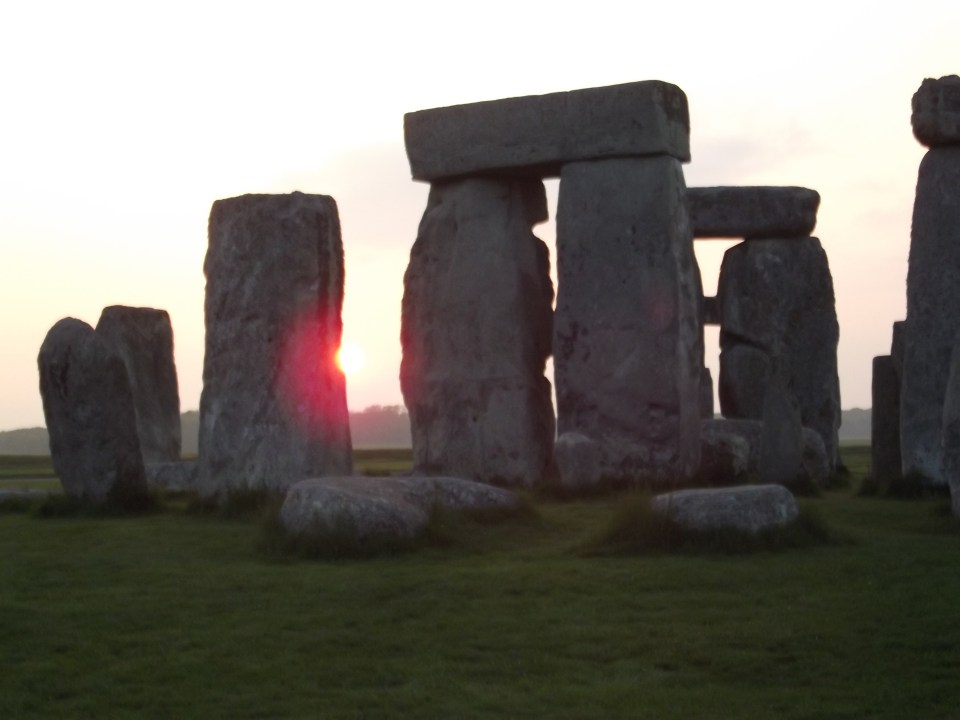
No one has ever been quite sure where the famous circle of giant bluestones came from or how they came to be arranged in such a precise formation in the wilds of Wiltshire.
A recent paper from researchers at UCL suggested that the stones were collected in at quarries Carn Goedog and Craig Rhos-y-felin around 5,000 years ago, then dragged from Wales to Wiltshire by men.
But archaeologists writing the Archaeology in Wales journal says that UCL got it all wrong.
This newer report says there are “no traces of human intervention in any of the features” that the UCL researchers “so excited”.
Instead, the Arachaeology in Wales paper’s authors, Dr Brian John, Dr Dyfed Elis-Gruffydd and John Downes, think they have evidence that suggests the rocks were moved by glaciers.
Accusing the UCL team of getting carried away by a good yarn, Dr John wrote, “There is substantial evidence in favour of glacial transport and zero evidence in support of the human transport theory.
“We think the archaeologists have been so keen on telling a good story here that they have ignored or misinterpreted the evidence in front of them.
“That’s very careless. They now need to undertake a complete reassessment of the material they have collected.”
Visit Stonehenge and explore the ancient landscape with a local expert tour guide and hear all about the many new theories. Our Stonehenge Special Access Tours allow you to enter the inner circle and walk freely amongst the Stones at sunset or sunrise
The Stonehenge Travel and Tour Company
Mystical Landscape Magical Tours
http://www.StonehengeTravel.co.uk
Early Britons: Have we underestimated our ancestors?
Have we underestimated the first people to resettle Britain after the last Ice Age? Evidence from a variety of sources suggests that early Britons were more sophisticated than we could have imagined.
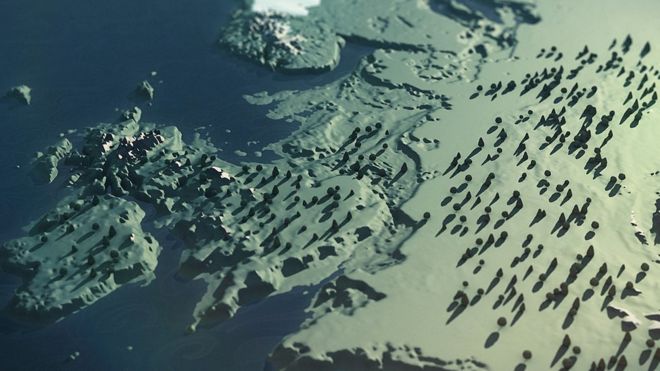
Archaeologists once thought that the story of the early hunter-gatherer Britons was lost to the mists of time.
The hunter-gatherers left almost no trace of their nomadic existence behind.
As a result, the stone-age settlers of ancient Britain were thought of as simple folk, living a brutal hand-to-mouth existence.
But now, evidence is emerging that turns those assumptions upside down. Archaeological sites all over the UK and northern Europe are producing evidence that paints these people in a very different light.
Thanks to this cutting-edge science, we now have an increasingly clear picture of prehistory, and the adaptable, culturally rich, and sophisticated people who inhabited these islands.
A BBC Horizon documentary, screened on Wednesday, tells the story of this quest to understand the first Britons.
Some of these Mesolithic, or Middle Stone Age, people lived at Blick Mead, Wiltshire – a few miles away from the future site of Stonehenge.
Here, groups seem to have managed and cleared rich forests, built structures and returned to the same place for over 3,000 years, according to a radio carbon date range that has yielded a uniquely long sequence for any Mesolithic site in Britain and Europe – 7,596-4,246 BC.
The springs at Blick Mead may have been the initial and practical reason why people lived there long before Stonehenge was built.

They have also preserved the remains of the animals they killed, tools they made and used, and possibly a structure they lived in.
The quantities of flint tools and animal bones, especially from extinct wild cattle known as aurochs, point to people living here for long periods of time and there being long-term special memories and associations with the place.
The types and variety of flint seem to reflect the movements of people who followed game with the seasons, and chose to stay in different areas according to the changing availability of plants for food and materials, and the needs for shelter.
Taken together, the flint and other stone tool evidence suggest that Blick Mead was a feasting and gathering place for thousands of years that people travelled large distances to reach. Far from it being a place nomads dropped into once in a while, time would have been spent there, ideas exchanged and new technologies discussed and adapted.
Hunter-gatherers prospered in Britain, but then, 6,000 years ago there was a dramatic and permanent change in the way our ancestors lived their lives. So dramatic in fact that it’s been given a different historical name. This was the start of the new Stone Age in Britain – the Neolithic.

It was during the Neolithic that pottery emerged, the time when people built monuments like Stonehenge – but above all else, it’s the point at which people became farmers.
Scientists and archaeologists have begun to uncover evidence that local hunter-gatherer ways survived the arrival of farming rather than being extinguished, as is often depicted.
And at Blick Mead, where rare evidence of hunter-gatherer life is so well preserved, finds include bones of mice, toads and fish – we can also discover more about the origins of Stonehenge.
Excavations at the site are showing that people were living in the area from the time of the first monuments to be built at Stonehenge.
We have always thought of Mesolithic people, the first Britons, as hunter-gatherers, living a nomadic life, primitive and precarious. But what has been recently revealed at Blick Mead, and elsewhere, is the existence of a much more complex, dynamic society.
The dramatic discoveries at Blick Mead are only partly important because they provide the back story to the Stonehenge story; they are also important because they reflect the growing importance of these peoples to British history generally.
And these earliest British stories are showing that the Mesolithic was a defining period in the history of these isles.
Wiltshire house rivalled Stonehenge as a hub for ancient Britons
Neolithic building on vast site at Marden Henge is welcoming public visitors again after thousands of years buried beneath farmland.

Pieces of flint tools dropped more than 4,300 years ago on the floor of a house as old as Stonehenge have been laid bare on the edge of Marden Henge, a giant ditch and bank enclosure so buried in rich Wiltshire farmland that it has almost vanished from view.
“We’ve over-fetishised Stonehenge for far too long, because those giant trilithons are just so damn impressive,” said Dr Jim Leary, director of this summer’s excavation with the Reading University archaeology summer school, in the lush Vale of Pewsey. “It could well be that this was really where it was at in the Neolithic.”
The rectangular building will welcome visitors next weekend for an open day which is part of the national festival of archaeology. The house, believed to be one of the best preserved from the period ever found in the UK, and made to look smarter with tonnes of white chalk brought from miles away and stamped into a kind of plaster, is as neatly levelled and regular as the nearby postwar bungalows built on top of part of the henge bank.
The house and other parts of the huge site have already produced finds including beautifully worked flint arrowheads and blades, decorated pottery including some pieces with the residue of the last meals cooked in them, shale and copper bracelets and a beautiful little Roman brooch – and the tiny jawbone of a vole. Analysis of the mass of seeds and charred grains recovered will reveal what the people were growing and eating.
Pig bones – probably the remains of at least 13 animals, food for hundreds of people – and scorch marks from a charcoal firepit suggest the house was never a permanent residence but connected with great gatherings for feasts. When it was abandoned the entire site, pig bones and all, was cleaned and neatly covered with earth, so it would never be used again.
The structure originally stood on a terrace overlooking a mound, within a small earth-banked circle, in turn part of the enormous Marden Henge.
Leary, joined by archaeology students, professionals and amateurs from all over the world, who will continue working on the site for years to come, is peeling back the layers of a monument that was once one of the biggest and most impressive in Britain. Ramparts three metres high enclosed a vast space of 15 hectares, far larger than the Avebury or Stonehenge circles, and too large for any imaginable practical use.
Leary believes the purpose must have been status, showing off wealth and power in the ability to mobilise a massive workforce. “Avebury had the huge ditches, Stonehenge upped the ante with the massive trilothons, Marden had this enormous enclosure.”
The site is so vast that it takes Leary and fellow director Amanda Clarke 40 minutes to walk from the team working on the house to the diggers who have uncovered a previously unrecorded Roman complex including the foundations of an impressive barn.
Like the Durrington Walls henge a few miles downstream, and Stonehenge itself, Marden was linked to the river Avon by a navigable flow, now a sedge- and nettle-choked stream, which forms one side of the henge.
“Avebury in one direction and Stonehenge in the other have been excavated and studied for centuries because the preservation of the monuments on chalk is so much better. Not nearly enough attention has been paid to the archaeology of the fertile valleys because the land is so good the monuments have often been ploughed out above ground – but it is a key part of understanding the story.”
Marden’s banks, cut through by later roads or lying under modern farm buildings, grazing cows and ripening crops in many places, once stood three metres tall, towering over an equally deep ditch. The outer ring enclosed a complex of smaller monuments, including the Hatfield Barrow, which was once 15 metres tall, and now survives only as a 15cm ripple in the field. It was excavated in 1807 and, after a collapse caused by the shaft, later completely levelled by the farmer.
The site welcomes visitors every day, but the open day will have finds on display, tours and activities. It will be among more than 1,000 events across the country over the last fortnight of July, including lectures, site tours and visits to archaeology stores and structures normally closed to the public.
- The Reading University archaeology summer field school open day takes place at Marden Henge, Wiltshire, on 18 July. The Council for British Archaeology festival of archaeology runs nationwide from 11-26 July.
Stonehenge and Avebury Guided Tours
http://www.StonehengeTravel.co.uk
St George : International Man of Mystery
The story of a dragon-slaying hero is legendary, but how much do we really know about the man behind the myth?

The Real St.George.
Much of St George’s life remains shrouded in mystery and mingled with myths and legend, so it’s difficult to separate fact from fiction.
◾It is thought that St George came from Cappodocia in Asia Minor, and lived at the time of the Roman Emperor Diocletian (AD 245 – 313), and became a high-ranking cavalry officer in the Army of Rome
◾To Christians, George is a historical figure who was beheaded in Lydda, Palestine (in AD 303) for refusing to carry out Diocletian’s orders for Christian persecution
◾He was canonised in AD 494, with Pope Gelasius proclaiming that he was one of those “whose names are justly revered among men but whose acts are known only to God”
So Where Did the Dragon Come From?
The dragon-slaying hero we celebrate every year didn’t actually become well-known until the 14th century, during the reign of Edward III. The story goes that St George rode into the city of Silene (modern day Libya), to find the people terrorised by a dragon which was fed daily with one of the citizens. St George rose out, slew the dragon and freed the people from their oppressor.
It is highly unlikely that St George ever visited England, but he was known here from as early as the eighth century. His reputation for virtue and chivalry became the spiritual inspiration for the Crusaders, and by 14th century the story had gained widespread popularity.
Did You Know?
◾St George is also the Patron Saint of Bavaria, Beirut, Portugal and Hungary, to name but a few. He’s also patron saint of soldiers, archers, cavalry and chivalry, farmers and field workers, riders and saddlers, and sufferers of leprosy, the plague and syphilis.
◾Baden Powell also named St George is also the patron saint of Scouts, as “St George was typical of what a scout should be.”
◾At the Synod of Oxford in 1222, St George’s Day was declared a public holiday.
◾Shakespeare died on St George’s Day 1616, and if the story is to be believed, was born on St George’s Day, 1564
English Heritage Events
Calling all knights, dragons and jesters… come and cheer on St George this April as he battles his dastardly fire breathing foe at a historic place near you.
Immerse your family in the action as you learn about England’s heroic patron saint and enjoy the range of fun and games on offer. History hunters of every age will enjoy getting hands-on and cheering our champion as he battles a mighty dragon in a quest to save the fair maiden.
Click here to view English Heritage Events
Stonehenge and Salisbury Guided Tours
Great News for Tour Operators as New Stonehenge Coach Park Plans are Approved.
26-space coach park is set to be built at Stonehenge and will operate for two years, councillors in Wiltshire have agreed.
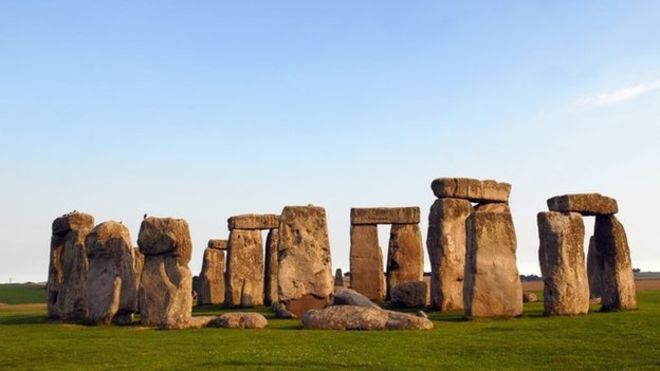
A temporary coach park will be built near to Stonehenge, Wiltshire Council has agreed
English Heritage will convert farmland next to the existing coach park and will include walkways for pedestrians.
Concerns had been raised over increased traffic, landscape impact and what would happen after the two-year period.
Wiltshire Council’s conditions include ensuring the land can easily be returned to its original state.
Last month, the council rejected plans to resurface an overflow car park on the grounds of visual impact on the landscape.
More than 1.3 million people have visited the prehistoric monument since the opening of a new visitor centre in December 2013.
Seven councillors approved the vote, with three against and one abstaining
Full story on the BBC news website
The Stonehenge Travel Company
Guided Tours of Stonehenge from Salisbury
All Cannings: Wiltshire’s ‘Neolithic’ long barrow burial chamber opens
Would you fancy spending eternity inside a burial chamber in the corner of a field in Wiltshire? I do!

Tim Daw and Arch Druid of Avebury blessing the Long Barrow
The first “Neolithic” long barrow to be built in the UK for 5,500 years has been completed and already the first urn of human ashes has been placed inside.
The structure at All Cannings near Devizes, took almost nine months to build, using traditional materials and stone working techniques.
The tomb, designed by farmer Tim Daw, has been positioned to let the midwinter sunrise shine right down the length of the chamber where people’s ashes will be placed in urns set into the walls.
What is a long barrow?
- Barrows are artificial hills of earth and stones built over the remains of the dead
- They were usually reserved for members of the social elite or Anglo-Saxon royalty
- Ordinary people were usually cremated or buried in more humble graves
- They were first constructed in about 4,000 BC up to the late pre-Christian era
- England’s most famous barrow is at Sutton Hoo in Suffolk
News link: http://www.bbc.co.uk/news/uk-england-wiltshire-29225327
Visit the Long Barrow website here: http://www.thelongbarrow.com/
We intend to include the Long Barrow on future tours and I have already booked a niche.
The Stonehenge Travel Company, Salisbury, Wiltshire
Stonehenge and Salisbury Guided Tours
http://www.StonehengeTravel.co.uk
English Heritage has opened five recreated Neolithic houses, in the shadow of Stonehenge.
The recently built Neolithic houses built by volunteers next to the new Stonehenge visitor centre have proved popular with tourists. Overseas visitors have found them fascinating. This recent international article in Newsweek gives an indepth insight:
Stonehenge Reconstructions Show Brits Have Always Been Houseproud
English Heritage has opened five recreated Neolithic houses, in the shadow of Stonehenge, revealing how the builders of the monument lived 4,500 years ago. At first glance, we could be forgiven for thinking they were built in the modern age. Certainly, their building techniques are very similar to those used on Victorian cottages in nearby Wiltshire villages. The walls were made from cob, a mixture of the local chalk and hay, slapped, when wet, onto seven-year-old hazel stakes. These walls were then topped with thatched roofs, made from knotted straw tied onto a woven hazel frame.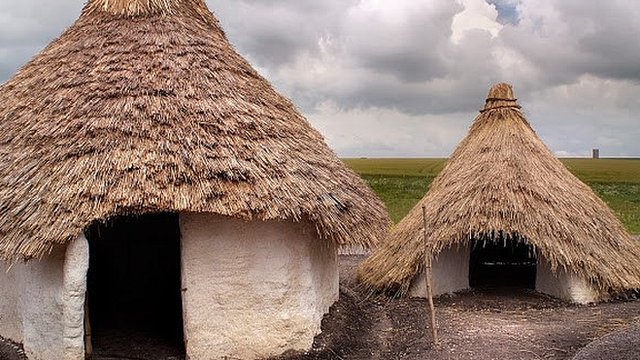
Far from being dark, little Hobbit spaces, the interiors are surprisingly bright, illuminated by the white chalk walls and floors, and open door. A tall man can easily stand up straight inside. In the middle of the room, the ash-log fire on the hearth sends up smoke, which seeps through the thatch. As the smoke slowly dissipates, it creates a thin carbon dioxide layer against the straw that stops any spark from the fire igniting the thatch. As if that weren’t ingenious enough, the thatch expands in the rain, providing an even more waterproof membrane.
The houses are pretty small – around 5m across – but they were certainly big enough to hold a family: English Heritage has managed to fit in 15 people easily into a single house, gathered around the fire.
It wasn’t just the architecture that was astonishingly avant-garde. Furniture in 2,500 BC, when Stonehenge and these cottages were thought to have been built, was pretty advanced too. Neolithic man slept on animal skins on wooden beds, with cupboards and shelves carefully inserted into the wall. In the house and outside the front door, there were handy pits, filled with handsome, striped pottery, known as “grooved ware”, the first pottery in Britain with a flat base. The pits also contained a selection of flints and animal bones, carved to create every conceivable mod con. Near Stonehenge, archaeologists have found chalk axes, bone tweezers, flint awls for piercing holes in bone and leather, flint saws and flint “fabricators” to create sparks for igniting fires.
The beauty of these objects – and the advanced engineering of the houses – seems particularly astonishing when we consider how early on in European, and global, civilisation they were made. In 2,500 BC, the Great Pyramid was being built at Giza, in Egypt. It was 500 years before the Minoan civilisation flourished at the Palace of Knossos; 900 years before the Mycenean civilisation in mainland Greece; and 2,000 years before the Parthenon was constructed. Jesus Christ is 500 years closer to us today than he was to the people who lived in these houses
Constructed over five months by 60 English Heritage volunteers, the buildings were closely based on the remains of Neolithic houses discovered in 2006 and 2007 at Durrington Walls, a ceremonial earthwork enclosure just north-east of Stonehenge. Radiocarbon dating has placed that settlement at about the same time that the mammoth sarsen stones from north Wiltshire, and the smaller bluestones from south Wales, were being raised at Stonehenge. So they’re among the earliest houses ever found in Britain.
Just like those nearby Wiltshire villages today, Durrington Walls consisted of a series of these cottages – and there may be 100s more, yet to be found – clustered closely together, but separated by woven wooden fences.
Again like lots of modern villages, Durrington Walls was built next to the River Avon – a crucial water source, home not just to trout and salmon, but to beavers and otters, much prized for their fur. Edible plants grew in the nearby damp soil, and red deer came to drink at the water’s edge. Deer antlers were used both as pickaxes and rakes to build the ditch and banks that circle Stonehenge. One red deer antler pick was found, laid carefully right on the floor of the ditch, perhaps to celebrate the end of the work.
The Flintstone diet wasn’t so different to ours, either: surviving cow and pig bones, some of them still with butchering marks on them, reveal a meat-rich diet, although there’s little trace of any cereal grain.
Already at this early stage, there are plenty of signs of human migration by water, too. The Amesbury Archer – whose burial was discovered in 2002, 5km east of Stonehenge – was born in the Alps, probably in what is now Switzerland. His origins were found thanks to chemical analysis of his teeth. The Amesbury Archer is thought to have been buried in 2,400 BC, a century after Stonehenge was built.
His body was surrounded by a glittering array of treasures: three copper knives, 16 flint arrowheads and a pair of gold hair ornaments, the earliest gold found in Britain. He was also buried with two archers’ stone wrist-protectors, which gave him his moniker. Alongside him, there were five delicately-carved and shaped Beaker pots, which gave their name to the neolithic Beaker culture, which spread right across western Europe, from present-day Holland to Spain, France and Germany.
The more archaeological research is made into Stonehenge man, the more evidence emerges that Britain wasn’t some remote backwater in the Neolithic Age, waiting for the Romans to provide it with the basics of civilised life. In the new Stonehenge visitors’ centre, hidden in a fold of Salisbury Plain close to the stones, there stands the skeleton of another early Neolithic Briton – whose recent bone analysis reveals quite how advanced this supposedly primitive civilisation was. The skeleton – excavated from a long barrow at Winterbourne Stoke, 3km west of Stonehenge – belonged to a man active in 3,000 BC, when the first earthwork enclosure at Stonehenge was built. Examining the enamel in his teeth – and the levels of strontium and oxygen, elements which vary in quantity from location to location – archaeologists have determined that he was probably born in Wales, moved to Wiltshire at two, went back to Wales at nine, and then shuttled between Stonehenge and Wales from 11 to 15. These regular journeys might explain the Welsh bluestones at Stonehenge – they were religious and sentimental reminders of the old country. This Neolithic man wasn’t so different from us. He was 1.72m, only 25mm shorter than the average British male today. He was 76kg, and lived off a classic West Country diet of dairy products and meat – mostly beef, mutton and venison.
Dr Simon Mays, the English Heritage scientist who carried out the bone analysis, determined that he’d led a peaceful life, with no injuries apart from a damaged knee ligament and a torn back thigh muscle. There was no sign of any illness, disease or nutritional stress in the body. He seems to have died in his late 20s or 30s. Life expectancy was a lot shorter, then, but what’s clear is that the great British obsession – class – was already alive and well 5,500 years ago. Our man was buried in one of the area’s grandest mausolea – and was initially the only body there, until he was joined around a thousand years later by other bodies in less prominent spots in the 82m-long grave.
There are around 350 of these long barrows in Britain. Half of them had no one buried in them at all; another quarter had five to 15 people in them; and only a quarter were allotted to a single person. So we are dealing with a major toff here, moving between his various smart residences in Wales and Wiltshire. A second home for the rich is nothing new.
The Durrington Walls houses may also help unlock one of the great secrets of mankind -–what was Stonehenge actually for? No one can be definitively sure but one of the most popular current theories is that it was a sort of holy cemetery. Its circles of cold stone, with cremated human bones all around, have been called “the land of the dead”. This is contrasted with “the land of the living” – with the timber houses of Durrington Walls, next door to another circular monument, Woodhenge, also built out of timber. Just walking around the Neolithic houses, we begin to see why this part of the West Country is so rich in Neolithic and Bronze Age finds. Not only is the open, rolling country so well-suited to farming – as it still is today – but also it’s purpose-built for house construction.
As visitors stroll around Stonehenge, they still kick up great lumps of chalk, studded with fragments of flint – the same chalk that built those ancient houses, the same flint that lit those long-extinguished ash fires. Suddenly, the Stone Age doesn’t seem so far away.
 Stonehenge and Salisbury Guided Tours