Home » Posts tagged 'World Heritage Site' (Page 2)
Tag Archives: World Heritage Site
Neolithic House Project: Stonehenge builders’ ‘bright and airy’ homes re-created
Five Neolithic houses have been recreated at Stonehenge to reveal how the ancient monument’s builders would have lived 4,500 years ago.

More than 20 tonnes of chalk, 5,000 rods of hazel and three tonnes of wheat straw were used
The single-room, 5m (16ft) wide homes made of chalk and straw daub and wheat-thatching, are based on archaeological remains at nearby Durrington Walls.
Susan Greaney, from English Heritage, said the houses are the result of “archaeological evidence, educated guess work, and lots of physical work.”
The houses open to the public, later.
The “bright and airy” Neolithic homes are closely based on archaeological remains of houses, discovered just over a mile away from Stonehenge.
Dated to about the same time as the large sarsen stones were being erected, English Heritage said experts believe they may have housed the people involved with constructing the monument.
Excavations at Durrington Walls, not only uncovered the floors of houses but stake holes where walls had once stood – providing “valuable evidence” to their size and layout.
“Far from being dark and primitive, the homes were incredibly bright and airy spaces” – Spokesman English Heritage

Sited by the new visitor centre, the houses are furnished with replica Neolithic axes, pottery and other artefacts
“We know for example, that each house contained a hearth and that puddled chalk was used to make the floor,” said a spokesman for English Heritage.
“And far from being dark and primitive, the homes were incredibly bright and airy spaces with white chalk walls and floors designed to reflect sunlight and capture the heat from the fire.”
‘Labour of love’
Using authentic local materials including 20 tonnes of chalk, 5,000 rods of hazel and three tonnes of wheat straw, it has taken a team of 60 volunteers five months to re-create the homes.
Susan Greaney, a historian at English Heritage, said it had been a “labour of love” and an “incredible learning experience” for the volunteers.
“One of the things we’re trying to do at Stonehenge is to re-connect the ancient stones with the people that lived and worked in the surrounding landscape,” she said.
“Now visitors can step through the door of these houses and get a real sense of what everyday life might have been like when Stonehenge was built. ”
They are furnished with replica Neolithic axes, pottery and other artefacts
Article source: BBC http://www.bbc.co.uk/news/uk-england-wiltshire-27656212
Link: http://www.theguardian.com/culture/2014/jun/02/neolithic-houses-recreated-at-Stonehenge
English Heritage: https://www.english-heritage.org.uk/daysout/properties/stonehenge/discover/neolithic-houses/
Stonehenge Neolithic Houses Blog
We operate guided tours of Stonehenge. Learn more about the Neolithic Houses and explore the Stonehenge Landscape with a local expert.
The Stonehenge Travel Company, Salisbury, Wiltshire
Mystical County, Magical Tours
Plains, Trains and Automobiles: Salisbury, Stonehenge and South Wiltshire is a truly unique destination
Take some time out and escape to Wiltshire this year. Find out more about this mysterious and beautiful part England.
The newly completed Stonehenge visitor centre deserves an extended visit. We recommend staying in Wiltshire and 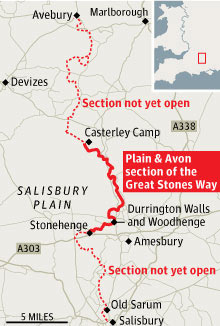 exploring the surrounding area, rich in history, myths and legends. Salisbury, Stonehenge and South Wiltshire is a truly unique destination. Set among some of the most beautiful countryside and with a 5,000 year old history the area is steeped in history but with its eye firmly fixed on the future.
Salisbury is a bit of a rail hub with main lines and frequent trains going east to London, south to Southampton and west to Bath and Bristol. Frequent trains run from London’s Waterloo station taking approximately 80 minutes to do the journey. There are normally two trains an hour operating up until very late evening. During the week, the cheap tickets are not available until after the morning commuter rush. Don’t worry if your accommodation is in London, its very easy to get to Salisbury or Bath from London by train and the trains run till late so there is still time to get back to London last thing.
Here are some examples of how accessible Wiltshire is using the Inter-City services from central London:
• London (Paddington) – Bath and Bristol via Swindon (55 mins),Chippenham (70 mins) and Great Bedwyn (90 mins).
• London (Waterloo) – Salisbury (90 mins) and Tisbury (103 mins).
 Salisbury is one of England’s most wonderful cities – a medieval masterpiece with something for everyone. From traditional English pubs to cosmopolitan street cafes and from hard-to-find specialist shops to major high street stores, you’ll find it in Salisbury. And at its heart there is the magnificent Salisbury Cathedral, towering over the city as it has for over 750 years. Step outside of the city and you are in another world. Green hills, crystal clear rivers and picturesque towns and villages just waiting to be discovered. And, of course, there’s Stonehenge. The world’s most famous stone circle stands just a few miles north of Salisbury – a must see destination.
Stonehenge Stone Circle is the most famous and enigmatic Megalithic site in the United Kingdom. Dominating the landscape of Salisbury Plain in the county of Wiltshire, the giant standing stones of Stonehenge – some weighing up to 50 tonnes – are a mysterious icon left by mysterious ancient peoples. You may have a special interest in burial chambers, the construction of Stonehenge, the purpose and culture of the people that built the henge.
English Heritage Stonehenge Visitor Centre. The fantastic new £27m visitor centre at Stonehenge is now open, offering tourists an interactive experience and the chance to examine prehistoric objects. Visitors are transported by shuttle bus more than a mile (2km) from the venue to see the stones.
Salisbury Plain
Discover prehistoric sites and rare species preserved on Salisbury Plain. An ocean of grassland and a sweep of big sky. Ancient  monuments loom out of the mist; camouflaged soldiers crouch in the undergrowth. Salisbury Plain is a landscape of extremes. It is the largest remaining area of chalk grassland in Northwest Europe and home to 2,300 prehistoric sites yet also the largest military training area on British soil.
Avebury Stone Circle Avebury rivals – some would say exceeds – Stonehenge as the largest, most impressive and complex pre-historic site in Britain. Avebury is part of a wider complex of Neolithic and Bronze Age monuments, with many other ritual sites in English Heritage care. West Kennet Avenue joined it to The Sanctuary, and another stone avenue connected it with Beckhampton. West Kennet Long Barrow and Windmill Hill are also nearby, as is the huge and mysterious Silbury Hill. This extraordinary assemblage of sites seemingly formed a huge ‘sacred landscape’, whose use and purpose can still only be guessed at. Avebury and its surroundings have, with Stonehenge, achieved international recognition as a World Heritage Site.
Mysterious Crop circles Salisbury Plain is well known for its crop circles and much mystery still remains as to why they occur and the meanings behind their complex formations. A tour of the ancient hills and vales of Wiltshire which are, inexplicably, the world capital of crop circles Crop circles in Wiltshire often occur around the heart of the county in and around Avebury, usually first appearing in April and continuing into the summer months. Crop circle guided tours can be arranged from Salisbury or Bath
Guided Tours from Salisbury can return to Salisbury or why not make the most of your sightseeing and be dropped off in Bath, Southampton or even London. Popular destinations can include: Salisbury Cathedral and the Magna Carta | Old Sarum Hillfort | Stonehenge Stone Circle and the new visitor centre | Woodhenge and Durrington Walls | Ancient Chalk Hill Figures | Pewsey valleys | Salisbury Plain and mysterious crop circles | Avebury Stone Circle | West Kennet Long Barrow | Silbury Hill | Lacock Village | Castle Combe Village | The Cotswolds | Glastonbury Tor and The Isle of Avalon
Needless to say private guided tours are bespoke and can be tailoured to suit your needs in the date(s) you wish to travel. Stonehenge private access tours allow you to enter the inner circle of Stonehenge before or after it is officially open to the public.
A once in a lifetime opportunity!
We would be delighted to arrange a private guide tour of Wiltshire and help you with your Salisbury Travel plans. Email us: tours@StonehengeTravel.co.uk or visit our website: http://www.StonehengeTravel.co.uk
Some Salisbury and Stonehenge links:
Visit Wiltshire: Discover things to do and places to visit across Wiltshire. Plan your visit, book hotels and accommodation and find out what’s on in the county. http://www.VisitWiltshire.co.uk
Download the Visit Wiltshire Apps here: http://www.visitwiltshire.co.uk/plan-your-visit/apps
Magnificent Salisbury Cathedral with the tallest church spire in the United Kingdom, home to the finest of the four surviving original Magna Carta 1215: http://www.salisburycathedral.org.uk/
Old Sarum Hillfort: http://www.english-heritage.org.uk/daysout/properties/old-sarum/
Longleat Safari and Adventure Park, in Wiltshire, England was opened in 1966 and was the first drive-through safari park outside Africa: http://www.Longleat.co.uk
Wilton House is an English country house situated at Wilton near Salisbury in Wiltshire. It has been the country seat of the Earls of Pembroke for over 400 years: http://www.WiltonHouse.co.uk
Amesbury Museum & Heritage Centre: http://www.visitwiltshire.co.uk/ideas-and-inspiration/amesbury-museum-and-heritage-centre-p1536253
Salisbury & South Wiltshire Museum: Showcasing the medieval Cathedral town of Salisbury and the ancient wonders of Stonehenge. http://www.salisburymuseum.org.uk/
The Cathedral Express. Wonderful days out by steam train: http://www.steamdreams.com/
English Heritage: http://www.english-heritage.org.uk/daysout/properties/stonehenge/
The Stonehenge Tourism Website: http://www.Stonehenge-Tourism.com
London to Salisbury Trains: http://www.thetrainline.com/
Discover Britain: http://www.discoveringbritain.org/walks/region/south-west-england/salisbury-plain.html
Guided Tours of Stonehenge and Salisbury http://www.StonehengeTravel.co.uk
For Stonehenge and Salisbury News follow us on Twitter: @SalisburyTours
Local Wiltshire Tour Guide
The Stonehenge Travel Company
Stonehenge Myths and Mysteries – Some New Theories
Latest Research and Theories About the World’s Most Famous Standing Stones.
Stonehenge. It stands on Salisbury Plain, massive, isolated and mysterious. People have been trying to fathom the meaning and history of the UK’s – and probably the world’s – most impressive and important standing stones for at least 800 years.

According to English Heritage, which manages the site about 90 miles southwest of London, early references have been found in the mid 12th century writings of Henry of Huntingdon, a Lincoln clergyman who wrote a history of England. Calling the site Stanenges, he wrote of stones of “wonderful size…erected after the manner of doorways, so that doorway appears to have been raised upon doorway; and no one can conceive how such great stones have been so raised aloft, or why they were built there.”
His questions – how was Stonehenge built, why was its location chosen and by whom – have puzzled generations of writers, researchers and visitors. Now, in the first decades of the 21st century, archaeologists are beginning to come up with some new answers – as well as a lot of new questions.
How Was Stonehenge Built and By Whom?
One of the great mysteries of Stonehenge is its actual creation. Some of its heaviest stones, the blue stones that make up the lintels, come from hundreds of miles away in the Preseli Hills of Wales. How were they transported by a society that did not use the wheel? And calling the monument “the most architecturally sophisticated prehistoric stone circle in the world,” English Heritage points out that while other Neolithic stone monuments were essentially piles of natural stones and boulders, Stonehenge is made of dressed stones, fitted together with precise mortise and tenon joints. When all the lintel stones of the outer circle were in place, they formed a perfectly horizontal, interlocking circle, even though the monument stands on sloping ground.
Early writers have theorized the monument was built by Romans – Inigo Jones thought no earlier people had enough engineering skill. In about 1136, Geoffrey of Monmouth in his history of Britain placed it in the heart of Arthurian legends and suggested that Merlin had a hand in building it. There are stories of Merlin flying the bluestones from Wales and levitating them to the top of the monument. And of course, there are plenty of stories of alien involvement.
Current theories are equally impressive though more down to earth. For ten years, in the Stonehenge Riverside Project, teams of archaeologists from the universities of Sheffield, Manchester, Southampton and Bournemouth, along with University College London, have been studying the monument and the surrounding landscape. They suggest that it was built as a unification project between farming tribes of East and West Britons who, between 3,000 BC and 2,500 BC, shared a common culture.
Professor Mike Parker Pearson of the University of Sheffield, author of Stonehenge: A New Understanding, explains, “there was a growing island-wide culture – the same styles of houses, pottery and other material forms were used from Orkney to the south coast…Stonehenge itself was a massive undertaking, requiring the labour of thousands… Just the work itself, requiring everyone literally to pull together, would have been an act of unification.” (Buy Prof. Pearson’s Book Direct).
In fact, a settlement being excavated about two miles northeast of the monument, Durrington Walls, indicates as many as 1,000 houses and 4,000 people from all over Britain took part in the building of Stonehenge. And this was at a time when the estimated population of the entire country was about 10,000. The village of builders was probably the largest Neolithic village in Europe.
So the manpower to undertake so much plain hard work was there. The stones were moved from Wales, via sledges and by boat, not by dark arts or secret sciences. Though the level of organization required at such an early period, is rather amazing.
Of course, that’s just the latest theory about the origin of the stones. Another idea is that the Preseli bluestones were carried to the Salisbury landscape by Ice Age glaciers and were found naturally littering the plain when Stonehenge’s builders walked the earth.
How Old is Stonehenge?
The common wisdom has been that the monument is about 5,000 years old and was built in several stages over a period of 500 years. In fact, much of the main building of Stonehenge, visible today, was probably built within that time frame.
But the use of the Stonehenge site for important, and probably ritual purposes goes back much further – perhaps as long ago as 8,000 to 10,000 years. Excavations around the monument’s parking area in the 1960s and then again in the 1980s found pits that held wooden posts planted between 8500BC and 7000BC.
It’s not clear whether these are directly related to Stonehenge but what is becoming more evident is that the landscape of Salisbury Plain was important to early Britons for many thousands of years.
Why Salisbury Plain?
Nice big landing place for spaceships perhaps? Not very likely. What is more probable is that the landscape chose itself. Ancient Britain was covered by forests. A large open space, thousand of acres of chalk grassland, would have been rare and special. I can tell you myself, that even today, driving across Salisbury plain at in the dark, its mysterious earthworks looming blank against a starry sky, can be a transcendant, almost supernatural experience.
Then, there is the matter of the lines. No not ley lines. Aerial photography, excavations and geophysical surveys have revealed grooves – known as periglacial stripes – that run parallel to the Avenue at the Stonehenge site and coincidentally line up with the axis of the solstice. It is possible that the farming people who settled the area and who closely observed seasonal signs noticed the alignment of these natural geological features and chose the site and position of Stonehenge because of them.
That certainly was the conclusion reached by Prof. Pearson’s group. He said, “When we stumbled across this extraordinary natural arrangement of the sun’s path being marked in the land, we realized that prehistoric people selected this place to build Stonehenge because of its pre-ordained significance…Perhaps they saw this place as the centre of the world”.
Was the Summer Solstice Important to Ancient People?
Every year, Wiccans, Neo Pagans, New Agers and curious tourists flock to Stonehenge for the summer solstice. It is the only time that visitors are allowed to camp out around the site and spend all night waiting for dawn.
But findings at Durrington Walls suggest that midwinter, not midsummer was the most important and the time for rituals and feasting. Scientists have been able to date pigs teeth found at the site and say that they were slaughtered and consumed in winter, not summer. Most of the other monuments in the Stonehenge area are aligned to midwinter sunrise and sunset. That theory makes even more sense when you consider the fire festivals and observances of midwinter all over Northern Europe.
What Was Stonehenge Used For?
Take your pick: Druid worship, burials, harvest festivals, animal sacrifices, solstice celebrations, communal rituals, a healing center, a farming calendar, a defensive earthwork, a signal to the gods, an alien landing strip. There are dozens of theories about what Stonehenge was used for. And over the years, archaeological excavations have found evidence of most of theses activities (except aliens – so far). The discovery of at least 150 burials in the area is a relatively recent finding, for example.
The fact is, the ritual landscape that Stonehenge is a part of was in use by different human societies for thousands of years. It’s likely that it, and the other monuments in the Stonehenge, Avebury and Associated Sites UNESCO World Heritage site, had a variety of different uses over the millennia. We may never fully understand this mysterious place, but archaeologists and historians are getting closer all the time. Article by By Ferne Arfin: http://gouk.about.com
Visit Salisbury, Stonehenge and its landscape with a local expert guide and hear all the latest theories about this mysterious monument.
The Stonehenge Travel Company, Salisbury.
www.StonehengTravel.co.uk
Scientists claim to have solved the mystery of Stonehenge’s location
Archaeologists who have been undertaking excavation work in the surrounding area of Stonehenge have claimed to have solved the mystery as to why the large circle of standing stones was constructed in the position it is in. However, it seems rather premature to be popping open the champagne bottles just yet as the evidence is far from conclusive.
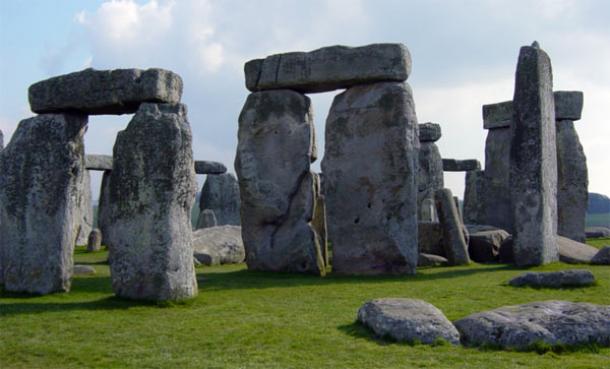 The team of scientists working in Amesbury, a short distance from where the landmarks sits on a hillside, believe the discovery of a ‘warm’ water spring provides all the answers they were looking for. It is claimed that Ice Age man was drawn to the nearby pools which never froze over and settled in the area to have access to the water.
The pools are fed by a spring which keeps the water at a constant 11 degrees, even in winter. Scientists visited the area in minus ten degree temperatures and found that the pools had not frozen over.
“The belief has always been that Stonehenge would not have been built here without there being something special about the area, said Andy Rhind-Tutt, chairman of the Amesbury Museum and Heritage Trust. “We believe the answer lies in the springs which feed the River Avon.”
The reason for Stonehenge’s location has remained one of the great unsolved mysteries of British prehistory, with no one theory accepted as correct. While the latest finding is interesting, it certainly appears too superficial to explain all the other evidence relating to Stonehenge’s location – were the warm springs a big enough motivation for Mesolithic settlers to drag megalithic blocks over 240 kilometres? Is the fact that it sits perfectly on a solstice axis now considered insignificant?
Hopefully scientists don’t believe this research is enough to close the file on the mysteries of Stonehenge.
By April Holloway (http://www.ancient-origins.net/news-history-archaeology/scientists-claim-have-solved-mystery-stonehenge-s-location-00952)
Join a guided tour from Salisbury and learn more.
The Stonehenge Travel and Tour Company, Salisbury Wiltshire
 Stonehenge and Salisbury Guided Tours